


Table of Contents
Share


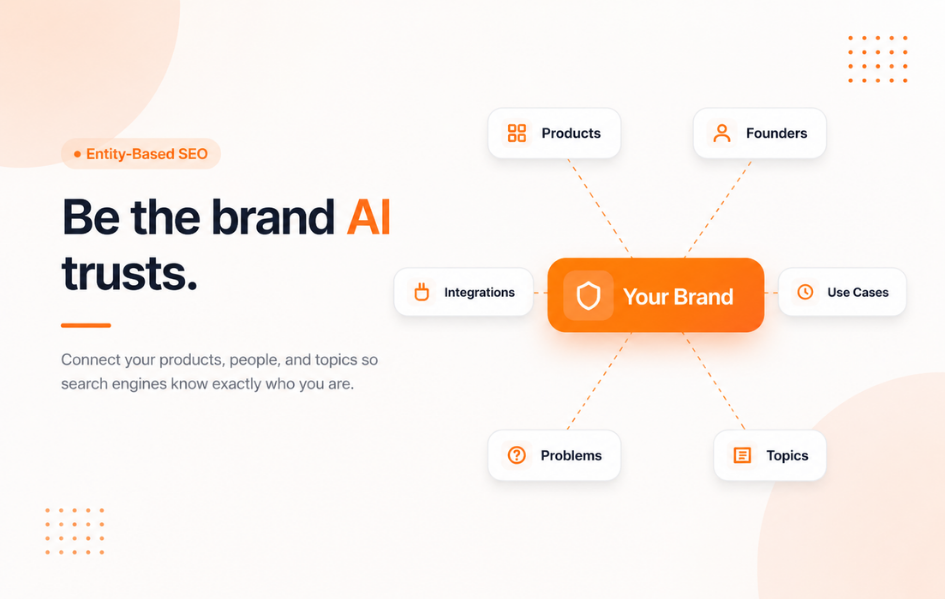
If Google and AI systems cannot distinguish what your software company represents, they will not trust it. That is the real job of entity-based SEO, ensuring your brand is clearly mapped within the Knowledge Graph so search engines can recognize your authority.
A lot of SaaS teams still publish content like it is 2018, focusing on one keyword, one page, and one hope. Meanwhile, buyers are asking Google, ChatGPT, Perplexity, and other AI search tools for direct answers, and disconnected content is no longer enough.
The fix is not more random content. It is a clearer identity layer that helps search engines and answer engines understand exactly who you are through the power of semantic SEO.
Key Takeaways
- Search engines have shifted from ranking keywords to ranking things not strings, focusing on entities and the relationships between them.
- Software brands need consistent naming, structured data to signal credibility, topic clusters, and outside mentions that verify their authority.
- The goal is not to create more pages for the sake of volume. The goal is a site that makes your company easier for search engines to understand and easier for users to trust.
- Rankings still matter, but so do branded search, AI mentions, topic coverage, and the potential for rich snippets that drive higher conversion rates.
Why Software Brands Need Clear Entities
Software companies are often messy in the eyes of search engines. Product names change, feature pages overlap, and messaging becomes fragmented. For example, one page might describe your solution as a customer support platform, another as help desk software, and a third as an AI service desk.
When your brand lacks a consistent identity, you fail to align with the specific search intent of your target audience. This disconnect makes it difficult for search engines to confidently interpret what your software actually represents. As a result, your visibility becomes diluted across competing interpretations.
The Problem: Fragmented Software Messaging
Software companies often create content in silos without a unified structure. Different teams describe the same product in different ways, which leads to inconsistent positioning across pages. This fragmentation weakens your ability to rank for clear, intent-driven queries.
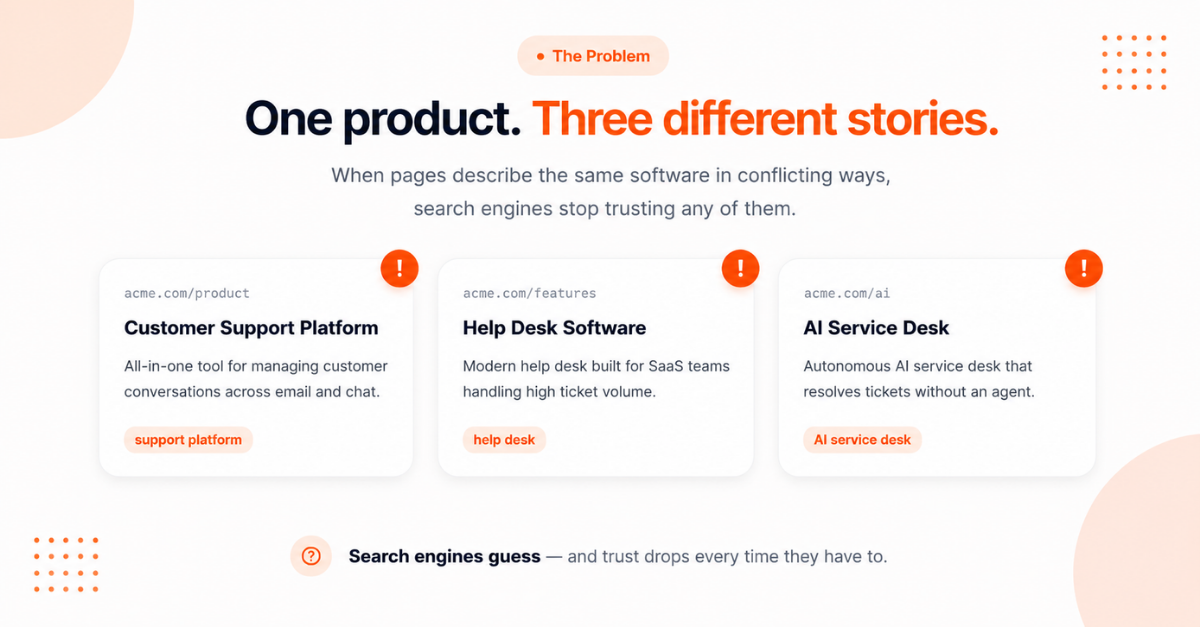
Without alignment, search engines are forced to guess how your pages relate to each other. That uncertainty reduces trust in your content and limits how often your pages are surfaced. Over time, this creates a ceiling on your organic growth.
How Entity-Based SEO Connects Everything
Entity-based SEO fixes this by helping search systems connect the dots through a robust entity relationship. Your company is an entity, as are your:
- Products
- Founders
- Integrations
- Use cases
- Specific problems you solve
By structuring your site to explicitly define these connections, you provide the signals necessary for engines to place your brand within the Google Knowledge Graph.
Search engines often use trusted sources like Wikipedia to validate these connections, so establishing a clear digital footprint is essential. Consistent entity signals across platforms strengthen how your brand is verified and understood.
Why Entity Structure Impacts Rankings and Visibility
When these relationships are clear, your site stops looking like a collection of disconnected URLs and starts acting as a verifiable source of authority. This depth of information is critical for your E-E-A-T signals, which demonstrate your experience, expertise, authoritativeness, and trustworthiness to both users and algorithms.
A well-defined entity structure also increases your chances of appearing in a prominent knowledge panel, which significantly boosts brand visibility. Strong entity clarity makes it easier for search engines to confidently associate your brand with specific topics and categories.
This matters more than ever because search is no longer just about ten blue links. Modern SEO now overlaps with answer engine visibility, where direct responses replace traditional rankings. If a buyer asks an AI tool for the best software in your category, those systems rely on clearly defined entity relationships to determine which brands to include.
A good breakdown of that shift is this entity SEO explainer for SaaS brands. It highlights how search engines and AI systems prioritize structured, connected information. Understanding this shift helps position your brand more effectively.
Paid traffic can fill the pipeline for a while, but it does not build long-term memory or genuine authority. Clear entity signals do, and they continue working to improve your organic presence long after the ad spend stops.
How Entity-Based SEO Works for Software Brands
Think of this process as building a definitive company record across the web. Instead of relying on isolated pages, search engines evaluate how your brand, products, and topics are structured and connected. The goal is to make those relationships explicit so machines can confidently interpret your business.
Structuring Entities at the Page and Site Level
At the page level, this involves using clear headings and schema to label your organization, products, and people. Implementing structured data in JSON-LD format is the industry standard for ensuring search bots accurately parse your site text. Through named entity recognition, machines analyze your content to determine entity salience, identifying which topics your brand truly represents.
At the site level, a hub-and-spoke model supports semantic search by organizing your content into clear relationships. This structure typically includes:
- Core pages that define primary topics
- Supporting pages that expand specific use cases or features
- Internal links that reinforce how these topics connect
This approach ensures your key entities are consistently supported across your site.
How Search Engines Interpret Entity Signals
Search engines interpret these signals through advancements in natural language processing. Updates like Google Hummingbird shifted search toward understanding concepts instead of matching keywords, while Google BERT improved how systems process context and intent. As a result, search now prioritizes meaning, relationships, and clarity over isolated keyword usage.
To strengthen your entity presence, your brand signals should remain consistent across:
- Your website
- Social profiles
- Partner or directory listings
This alignment makes it easier for search systems to verify and trust your brand.
Here is the simple test: if a machine had to explain your company in one sentence, could it do it correctly from your site alone?
If the answer is "sort of," you have work to do. Clear and consistent positioning across all platforms strengthens your entity signals and supports long-term visibility. This is also where topical authority becomes vital.
A solid B2B guide to entity SEO and topical authority makes the point well: topic clusters are the structure, but entities are the identity layer that gives those clusters meaning.
How to Structure Your Software Brand for Entity-Based SEO
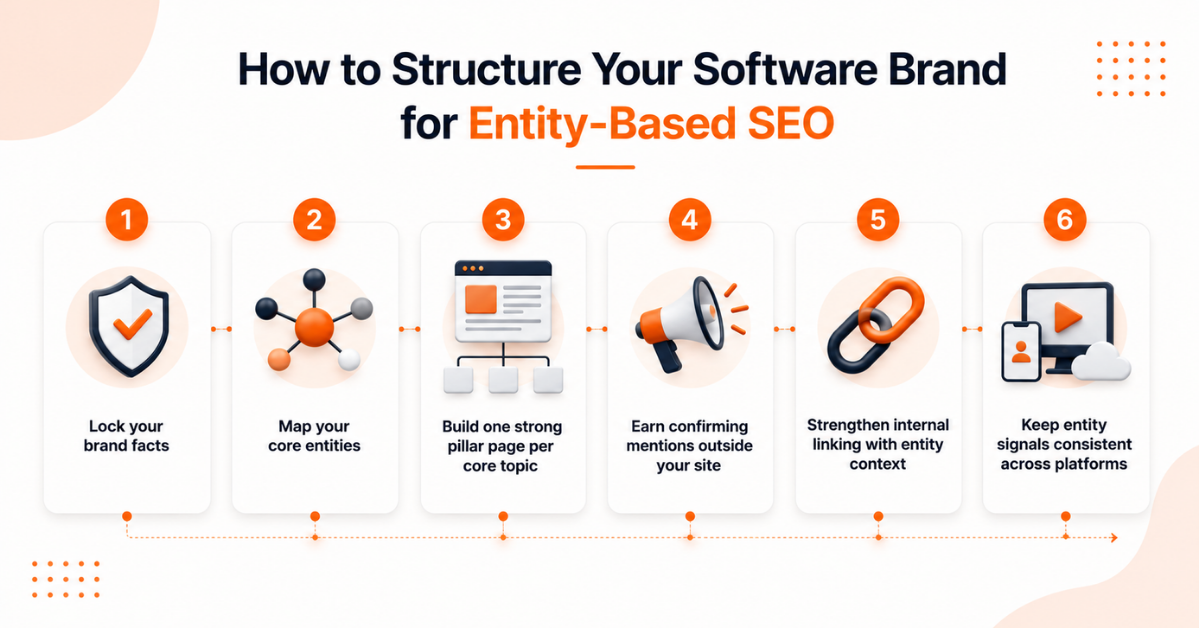
Don't overcomplicate it. Start with the core pieces that create clarity fast.
1. Lock your brand facts
Use the same company name, product names, category language, and leadership names everywhere. Implement robust schema markup to define your brand, and use structured data for your Product, Person, FAQ, and Article content to ensure search engines understand your context. This schema markup is the foundation of how search engines categorize your business.
2. Map your core entities
List your main product, supporting products, target users, integrations, major use cases, competitors, and adjacent concepts. This becomes your content map.
3. Build one strong pillar page per core topic
Then support it with pages for comparisons, integrations, implementation, pricing questions, workflows, and role-based use cases. Broad pages should link to specific ones, and specific ones should link back up.
4. Earn confirming mentions outside your site
Reviews, guest posts, podcast appearances, partner pages, and reputable industry writeups help search systems trust that your brand isn't only talking about itself. These mentions provide the information gain required to distinguish your brand from competitors.
By appearing on sites like Wikipedia or getting listed in Wikidata, you help search engines perform disambiguation. Even though Freebase is no longer active, the concept of a machine readable identifier remains vital for your presence in a knowledge panel or modern AI search results.
5. Strengthen internal linking with entity context
Many software brands miss the internal linking piece. They publish the pages, then leave them isolated, which is a waste of potential.
Effective internal linking should emphasize contextual relevance rather than acting like random related posts. This intentional entity linking ensures that your site architecture matches how users discover your solution.
It is also one reason a smart featured snippet strategy for software brands often works better after the entity layer is cleaned up.
6. Keep entity signals consistent across all platforms
And don't stop at written content. If you are using video, keep the same entity signals there too.
Your YouTube channel, speaker bios, and video topics should reinforce the same company story. Buyers search everywhere now, and consistent entity linking across platforms builds the digital authority necessary to stay visible.
Frequently Asked Questions
Below are some questions that might help you:
What is the Google Knowledge Graph and why does it matter for my software brand?
The Knowledge Graph is Google's massive database that connects entities—like your company, products, and founders—to understand their relationships and context.
By mapping your brand within this system, you move beyond mere keyword matching and establish verifiable authority. This is what search engines and AI tools rely on for direct answers.
How does structured data improve my entity-based SEO?
Structured data, typically implemented as JSON-LD, acts as a machine-readable blueprint that tells search engines exactly what the content on your page represents.
This technical layer removes ambiguity and ensures that your software features, pricing, and company information are correctly parsed. As a result, everything is accurately attributed to your brand identity.
Is entity-based SEO replacing traditional keyword research?
Entity-based SEO is not replacing traditional keyword research, but rather evolving the focus from simple text strings to the concepts behind them. Keywords still help identify what users are searching for.
Entity SEO ensures your site provides the comprehensive, interconnected information necessary to satisfy modern AI-driven search engines.
How can I prove my brand's authority to search engines?
You build authority by maintaining consistent naming and messaging across your site, supported by structured data and relevant internal linking.
Additionally, earning mentions on reputable third-party sites helps search systems validate your brand’s existence and expertise. This moves you closer to a prominent knowledge panel.
Let’s Make Your Brand Easier to Understand and Trust
Entity-based SEO is not about chasing algorithms. It is about removing confusion so search engines and AI systems can clearly recognize who you are, what you offer, and why it matters. When your brand is structured and consistent, everything else becomes easier, from rankings to conversions to long-term visibility.
Start by tightening what already exists, then build from there. Clarify your entities, connect your content, and create the right content to support it. Make your brand easier for both machines and people to understand with the help of Refresh. Call now!
.svg)
