

Most SaaS teams do not have a video problem. They have a topic problem.
They publish demos, webinars, and feature clips, then wonder why views stall and signups barely move. Effective video keyword research fixes that. It tells you what buyers already want, how close they are to a decision, and which format gives you a real shot at discovery.
In 2026, that matters even more. Video shows up in Google, YouTube, and AI-driven answer experiences, so mastering YouTube SEO is the core engine that ensures the right topic keeps working long after you publish it.
If you want a quick walkthrough before building your own process, this is a solid starting point.
Key Takeaways
- Focus on buyer pain points instead of prioritizing high search volume metrics.
- Split topics by funnel stage, because "what is" and "best tool" searches do not behave the same.
- Check YouTube results, Google video results, and sales conversations before you trust a keyword.
- A strong topic has a clear next step, like a demo, trial, or product page visit.
- Maximize your reach by optimizing technical elements like video tags to ensure your content reaches the right audience.
- The goal is not to create more videos. It is to create videos that compound into traffic, trust, and signups.
Start With Buyer Intent, Not Search Volume
Here is the mistake: teams chase the biggest phrase in the category based solely on search volume, then build a video for people who were never going to buy.
Would you rather get 500 views from students doing research, or 50 views from an ops lead trying to fix a painful workflow this quarter? Your target audience matters far more than vanity metrics. That is the whole game.
For SaaS, the best topics usually live in three buckets based on search intent:
- Pain-driven searches that often rely on long tail keywords to describe specific problems, blockers, or inefficient workflows.
- Solution-aware searches where the buyer knows the category and wants options.
- Comparison searches where they are close to action and need confidence.
Views are nice. Buyer intent is what pays the bills.
So start where your market already talks. Pull questions from sales calls, onboarding calls, support tickets, win-loss notes, and site search. Then match those questions to how people search on YouTube and Google.
This matters beyond YouTube, too. Clear, structured video topics often support visibility in AI answers and Google's AI Overviews.
If your video and page explain a real problem in plain English, you have a better shot at showing up where people now ask for recommendations.
Build a Simple SaaS Video Keyword Map
Now, turn that raw topic list into a map you can act on. To effectively engage your target audience, use a simple framework to organize your content.
While you should keep an eye on search volume and monthly searches to understand interest, focus primarily on whether each topic helps your target audience solve a specific problem.
Funnel StageSearch ThemeBest Video AngleProblem AwareWhy is our trial conversion dropping?Short explainerSolution AwareBest product analytics softwareCategory breakdownProduct AwareMixpanel vs AmplitudeComparison videoPost-PurchaseHow to build a retention dashboardTutorial
This keeps your video plan from collapsing into random uploads. It also stops the classic mistake of publishing ten top-of-funnel videos and wondering why none of them create pipeline.
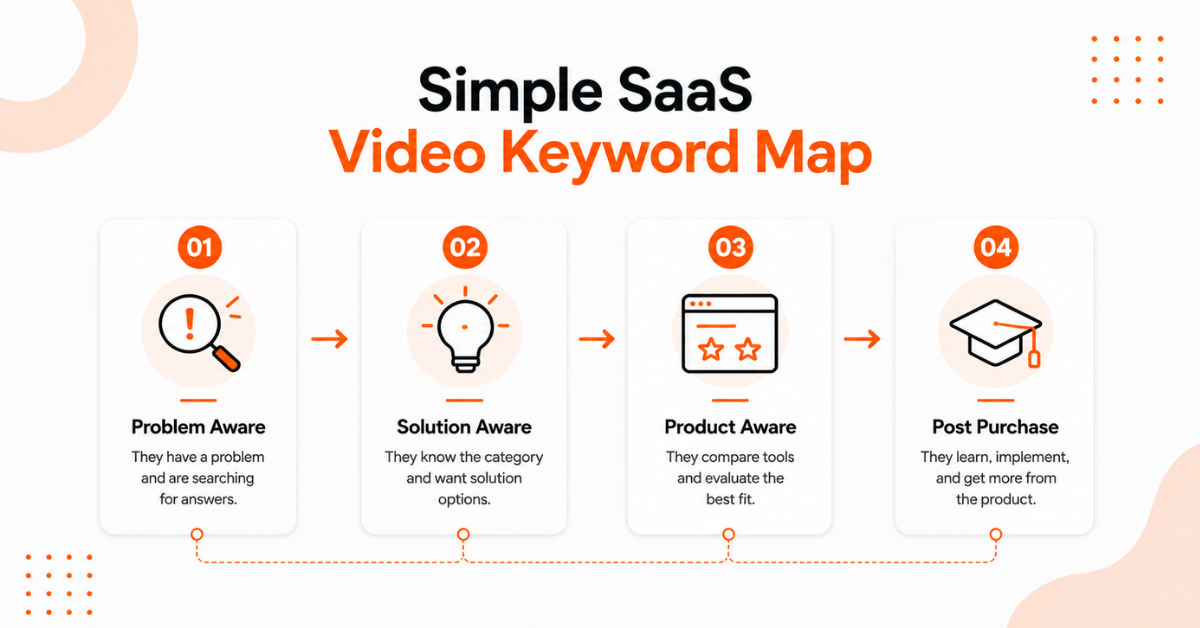
For each topic, write down four things:
- The main phrase
- Close variations
- The promise of the video
- The next step you want
That last part matters. If the keyword cannot lead naturally to a trial, demo, template, or deeper resource, it might be a fine awareness topic, but it is not a priority.
For these specific entries, prioritize long tail keywords that match user intent, and ensure your video title is optimized to address that exact search query.
In 2026, format matters more than ever. YouTube Shorts can create demand fast, especially for pain-led hooks.
Longer YouTube videos still win for tutorials, comparisons, and software walkthroughs. You do not need one format. You need the right format for the intent.
Find Topics in the Places Buyers Already Search
Begin by typing your core topics into the YouTube search bar to trigger YouTube autocomplete. This provides an instant look at what your audience is actually asking.
Then, verify these phrases by checking Google's main results and the video tab. If Google displays videos, it confirms that the query demands a visual answer.
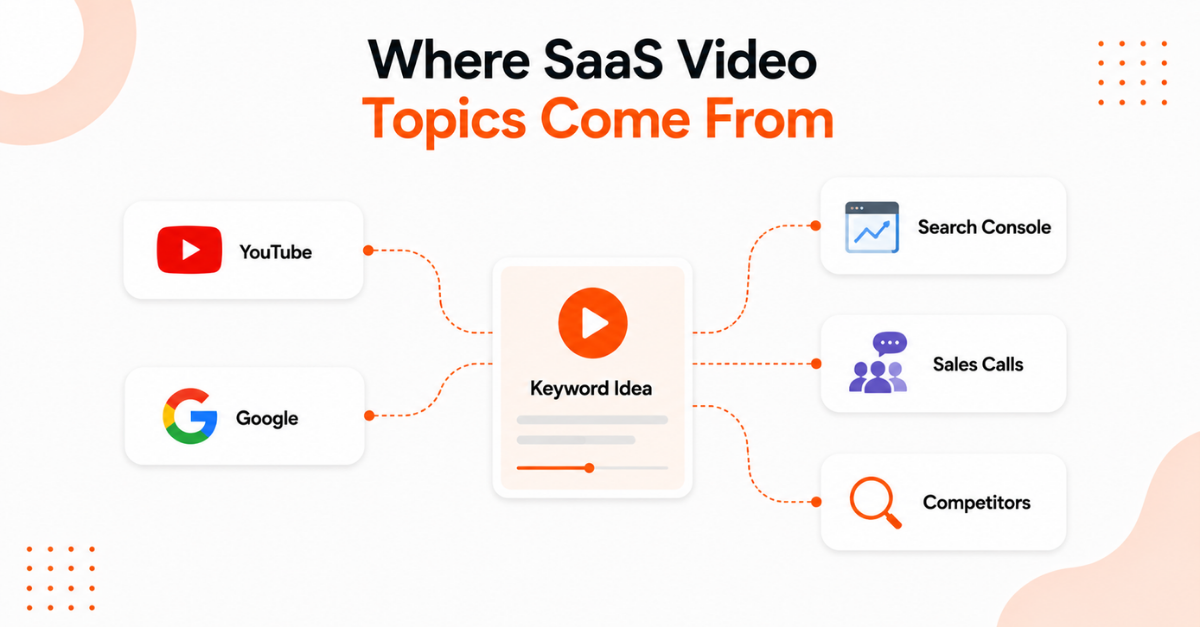
To dive deeper:
- Use tools like VidIQ or TubeBuddy to analyze the competition score and keyword difficulty.
- Use a keyword explorer to find matching terms for your video description.
- Review YouTube search results and related searches for overlooked subtopics.
Pay close attention to the YouTube search results and the related searches section, as these often reveal subtopics your competitors have overlooked.
Next, look at Search Console. Pages with impressions but weak click-through rates often hide strong video opportunities.
If a post ranks for a hard-to-explain process, a companion video can lift both discoverability and conversion.
Competitor channels are also vital for your YouTube SEO strategy, but avoid copying their titles word for word.
Instead, look for:
- Repeated questions in comments
- Recurring themes in their top videos
- Gaps they failed to fill
While free tools help with search volume and idea generation, remember that buyer context is always superior to raw data.
If you want a broader written framework, this guide to SaaS keyword research methods for 2026 is useful for spotting category, competitor, and pain-based terms.
Finally, do not treat video as an isolated channel. Pair strong YouTube topics with landing pages, transcripts, and on-site distribution. That is how video SEO strategies for software companies start turning views into durable search traffic.
Judge Keywords by Conversion Potential
Once you have compiled your list, score each topic with a little discipline. Beyond pure conversion potential, you should evaluate the keyword difficulty of each term to see if you can realistically rank.
Identifying specific content gaps where competitors are under-performing helps you build a genuine growth asset rather than just another video.
Ask yourself these three questions:
- Does the query match a problem your product solves well?
- Does the current results page reward video, or is it dominated by docs and forums?
- Is there a natural next step after the video?
If the answer is no on two of those, or if the competition score is too high to justify the effort, drop it.
This is where a lot of SaaS teams get boxed in. They pick topics that are interesting or educational but disconnected from any buying motion. That is just content, not growth.
The better play is simple. Pick the terms where your company can provide the clearest answer, prove credibility fast, and move the viewer one step closer to action.
To maximize your YouTube SEO, ensure your video title, video description, and video tags all work together to signal relevance to both algorithms and potential customers.
FAQs About Video Keyword Research
Below are questions you might also ask.
Should SaaS Teams Target High-Volume Keywords First?
Usually, no. While it is tempting to chase high monthly searches, these terms often bring broad, low-intent traffic that fails to convert.
Instead, begin your research by identifying a core seed keyword that defines your solution. Rather than focusing on trending keywords that may lack long-term relevance, prioritize problem-aware and comparison topics.
Always evaluate your target terms against keyword difficulty scores to ensure you can compete effectively within the YouTube search results.
How Long Should a SaaS Video Be for Search?
A SaaS video should match the user intent rather than a specific time limit. Short clips, often 15 to 30 seconds, work well for awareness, while tutorials and product-led searches usually perform best between 5 and 12 minutes.
When analyzing whether your content is hitting the mark, track metrics like views per hour rather than just total counts. Relying on historical data from your own channel size helps you determine the ideal duration that keeps your specific audience engaged.
Do I Need Separate Research for YouTube and Google?
Yes, because YouTube and Google are distinct platforms, even though there is significant overlap. YouTube often favors clear how-to phrasing, while Google may reward videos when the topic is easier to understand visually.
To improve your visibility, follow a comprehensive SEO checklist for every upload. This includes optimizing your video title, writing a detailed video description, and selecting relevant video tags.
Understanding how the YouTube algorithm weighs these ranking factors is essential. If you are stuck, look at related searches to uncover the specific terminology your prospects use to find solutions, which helps bridge the gap between platforms regardless of the initial search volume.
Ready to Build a Smarter Video Keyword Research Strategy?
The best SaaS video keyword isn't the biggest one. It's the one tied to a real pain, a clear search pattern, and a logical next step. By mastering video keyword research and prioritizing YouTube SEO, SaaS brands can consistently play nicely with the YouTube algorithm to drive long-term growth.
Get that right, and video stops being a content side project. It becomes an organic growth asset that keeps earning traffic, trust, and signups over time.
If your team wants help turning video research into a compounding organic channel across SEO, AI visibility, and YouTube, you can Book a Call.


