
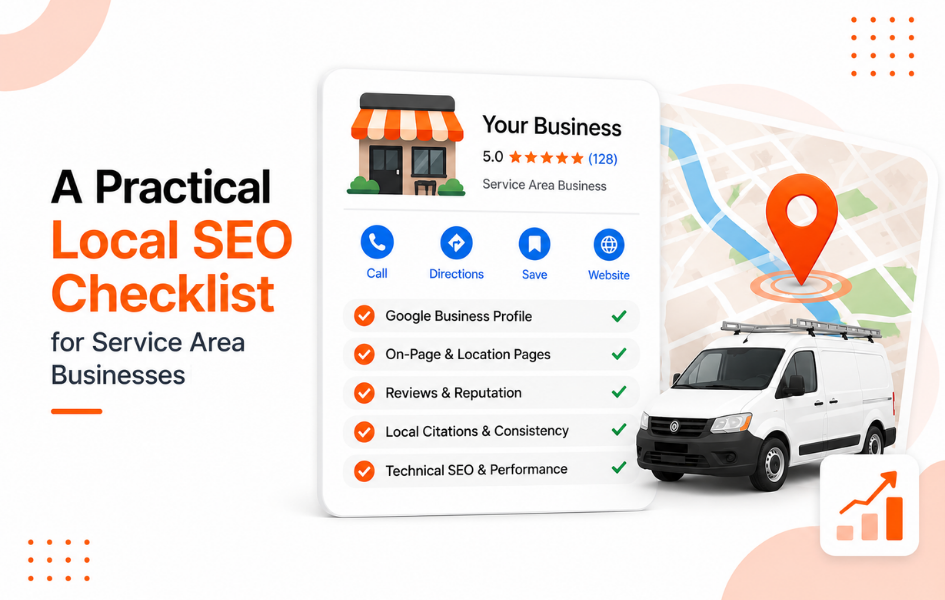
Paid ads can keep the phone ringing, but the lead flow often disappears when the budget stops.
That is why a strong local SEO checklist matters for plumbers, HVAC companies, electricians, roofers, cleaners, locksmiths, landscapers, and other businesses that travel to their customers.
In 2026, you are not only competing in the map pack. You are also competing in your Google Business Profile, local search results, AI Overviews, and the trust signals potential customers review before they ever call.
Because customers searching for these services have high local intent, visibility at the exact moment they need help is critical for sustainable growth.
Let's get your foundation right.
Key Takeaways
- Your Google Business Profile remains the most influential factor for local visibility. Proper category selection, detailed service setup, consistent hours, and an active review strategy are essential for success.
- Your website must clearly demonstrate your service areas. Google will not rely on a simple map radius alone. You need concrete content that proves where you operate.
- Online reviews serve a dual purpose. They help improve search performance while building the credibility needed to convince potential customers to call.
- Service area businesses succeed when they make three elements obvious: where they work, what services they provide, and why local customers trust them.
- In 2026, local SEO extends beyond traditional search and into AI-driven discovery. Clear answers, accurate business information, and strong reputation signals can improve visibility when users ask for recommendations.
- This work compounds over time. A single optimized page, a well-managed profile, and a consistent review system can generate leads long after they are implemented.
Step 1: Your Local SEO Checklist for Google Business Profile
For a service-area business, your Google Business Profile is often the first impression. Not your homepage or your quote form.
By prioritizing your Google Business Profile, you ensure that potential customers see the right information immediately.
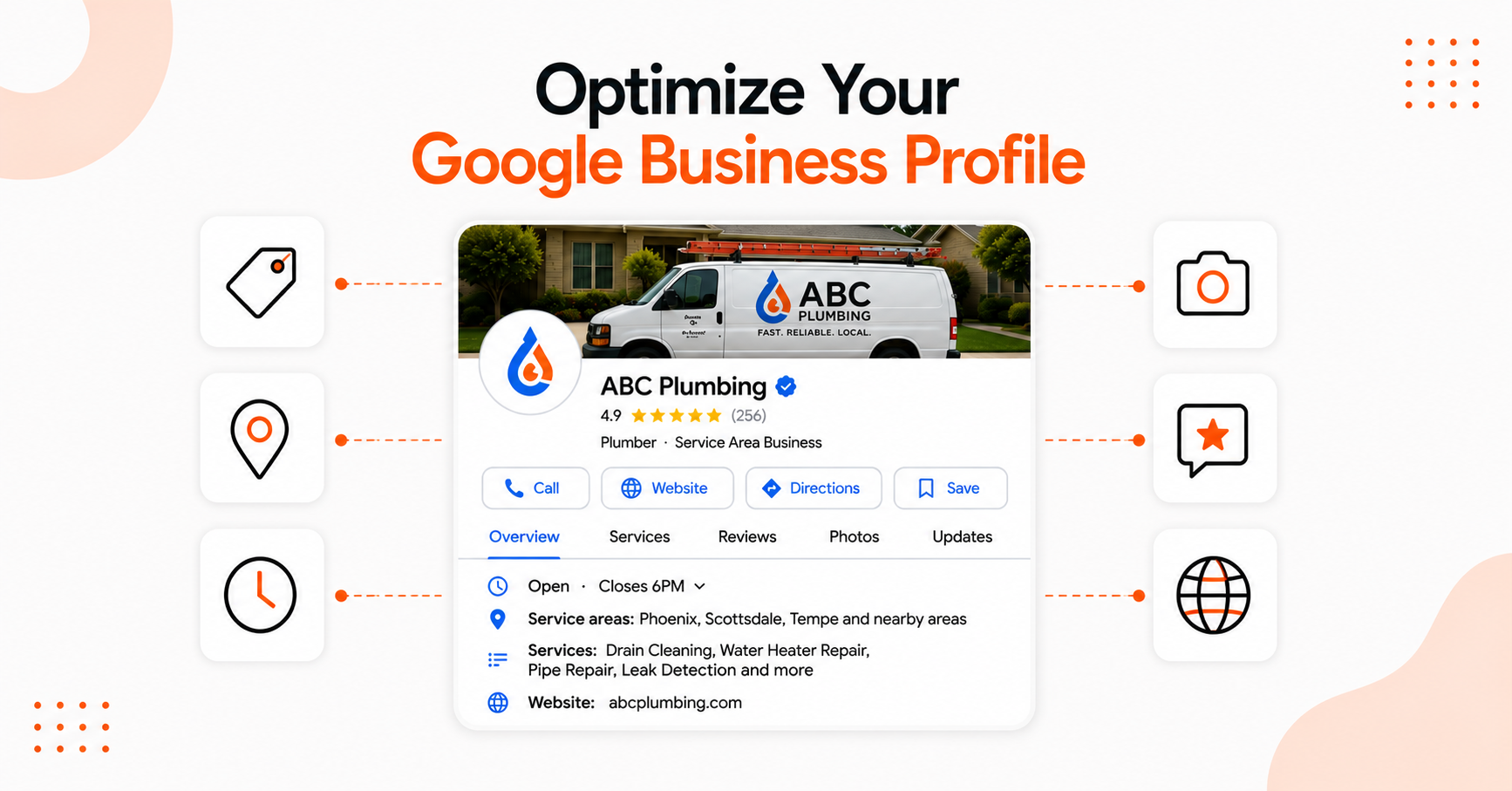
Choosing the Right Business Categories
Start with the primary category. This is one of the biggest relevance signals you control.
If you are a plumber, pick Plumber, not something broad like Contractor. Selecting accurate business categories is essential for ranking.
Secondary business categories are helpful too, but only when they match the actual services you offer.
Optimizing for Google Maps
Fill out the entire profile to maximize your visibility on Google Maps.
Complete every section of your profile, including:
- Service areas
- Service list
- Business description
- Hours and holiday hours
- Phone number
- Website
- Booking link
- Photos
If customers do not visit your location, hide the address publicly and set the business up as a service-area business. You still need a real address for verification, but you do not need to broadcast it if you operate from home.
Completing every field helps you rank higher in the map pack because Google rewards the most comprehensive listings.
Photos matter more than a lot of owners think. Upload real job photos, team photos, vehicles, tools, and before-and-after shots. Stock images are easy to spot and do not build trust.
Keep your presence active to maintain your rank on Google Maps. Add fresh photos, answer questions, and watch for user edits. A stale profile sends the wrong message, even if your business is solid.
Finally, remember that online reviews belong inside this strategy. Incorporating consistent review management is like keeping the lights on in your storefront, ensuring that you convert profile views into actual customers.
Step 2: Leveraging On-Page SEO and Location Pages
Your Google Business Profile opens the door, but your website closes the deal.
To capture qualified traffic, you must prioritize on-page SEO by creating a dedicated landing page for every core service you provide. Whether you specialize in drain cleaning, water heater repair, panel upgrades, AC installation, roof leak repair, house cleaning, or lawn maintenance, each offering deserves its own page.
Do not bury six distinct services on one generic page and hope Google sorts it out. Instead, optimize these pages with relevant local keywords to help search engines understand exactly what you do and where you do it.
Service Page Fundamentals
A high-performing service page does not ramble.
Every service page should clearly explain:
- The service you provide
- The problems you solve
- Signs a customer needs help
- What to expect during the process
- How to get started
To maximize impact, back up your content with local proof, client reviews, project photos, and FAQs.
Using internal linking to connect these service pages to your location-specific case studies or testimonials reinforces your authority. It also helps customers navigate your site more effectively while signaling relevance to search engines.
The Role of Location Pages
Now let us address the strategy for location pages because this is where many businesses go off the rails.
You do not need 80 thin pages with identical copy and a different city name pasted into the headers. That approach is outdated, lazy, and easy for search algorithms to identify as spam.
You should only create location pages for the areas that matter most, provided you can make them authentic.
Authentic location pages often include:
- Specific neighborhood names
- Common local home types
- Seasonal maintenance issues
- Regional permit quirks
- Local storm patterns
- Travel times
- Area-specific job examples
- Local testimonials
If you cannot provide real job examples or testimonials specific to that area, it is better to skip the page entirely.
The core objective is to provide Google with evidence that your business is deeply rooted in a specific place, rather than simply claiming you serve all nearby cities.
By focusing your location pages on genuine geographic relevance and using local keywords naturally throughout the text, you build assets that continue to perform over time.
If you are building a larger visibility system and want to think beyond one-off tweaks, the logic behind hiring an organic growth agency is the same here: build assets that keep working instead of renting every visit forever.
Step 3: Make Reviews and Social Proof Part of the Job
This is one of the most important part you should never forget.
Build a Proactive Review Strategy
A lot of local businesses treat online reviews like dessert. They think it is nice if it happens but not essential.
This is a mistake, as online reviews are actually part of the main meal.
The best strategy is simple:
- Ask every happy customer
- Ask them quickly
- Make the process easy
The sweet spot is right after the job is complete and the customer feels the result of your work.
Send a short text or email with the review link. Keep the request human and avoid scripts that sound like a robot wrote them.
What matters in 2026 is not just the total volume of feedback.
The factors that matter most include:
- Recency
- Frequency
- Relevance
A steady stream of honest feedback helps improve your local rankings, which is far more effective than one big burst of reviews followed by six quiet months.
When possible, encourage customers to provide useful details. A review that mentions the specific service, the city, the speed, or the quality of the technician gives both Google and future buyers more context.
This added clarity helps Google understand your business better, which can improve your position in local search results. Do not coach people into weird keyword stuffing, but simply ask for an honest description of what was done.
You must reply to every review.
Thank the customer and mention the service naturally. When handling negative feedback, stay professional because potential customers are reading your responses.
Incorporating consistent review management into your daily workflow shows that you value your clients and stand behind your work.
Showcasing Social Proof
Take that proof beyond your Google profile.
Strong trust signals include:
- Customer reviews
- Licenses
- Insurance details
- Certifications
- Warranty information
- Team bios
- Project photos
- Local partnerships
- Trade association memberships
If you sponsor a local team, belong to a trade association, or work with recognizable builders or property managers, showcase that information as well.
This is also where video starts pulling its weight.
A 30-second job walkthrough, a quick explanation of what happened on-site, or a before-and-after clip can do more than a long paragraph of generic sales copy. It builds trust quickly and gives you versatile content for your website, YouTube, and social media channels at the same time.
Step 4: Citations, Schema Markup, and Technical Foundations
Most local campaigns do not fail because of one dramatic mistake.
They lose because of sloppiness. If you want to rank effectively, you must eliminate the digital friction that confuses both users and search engines.
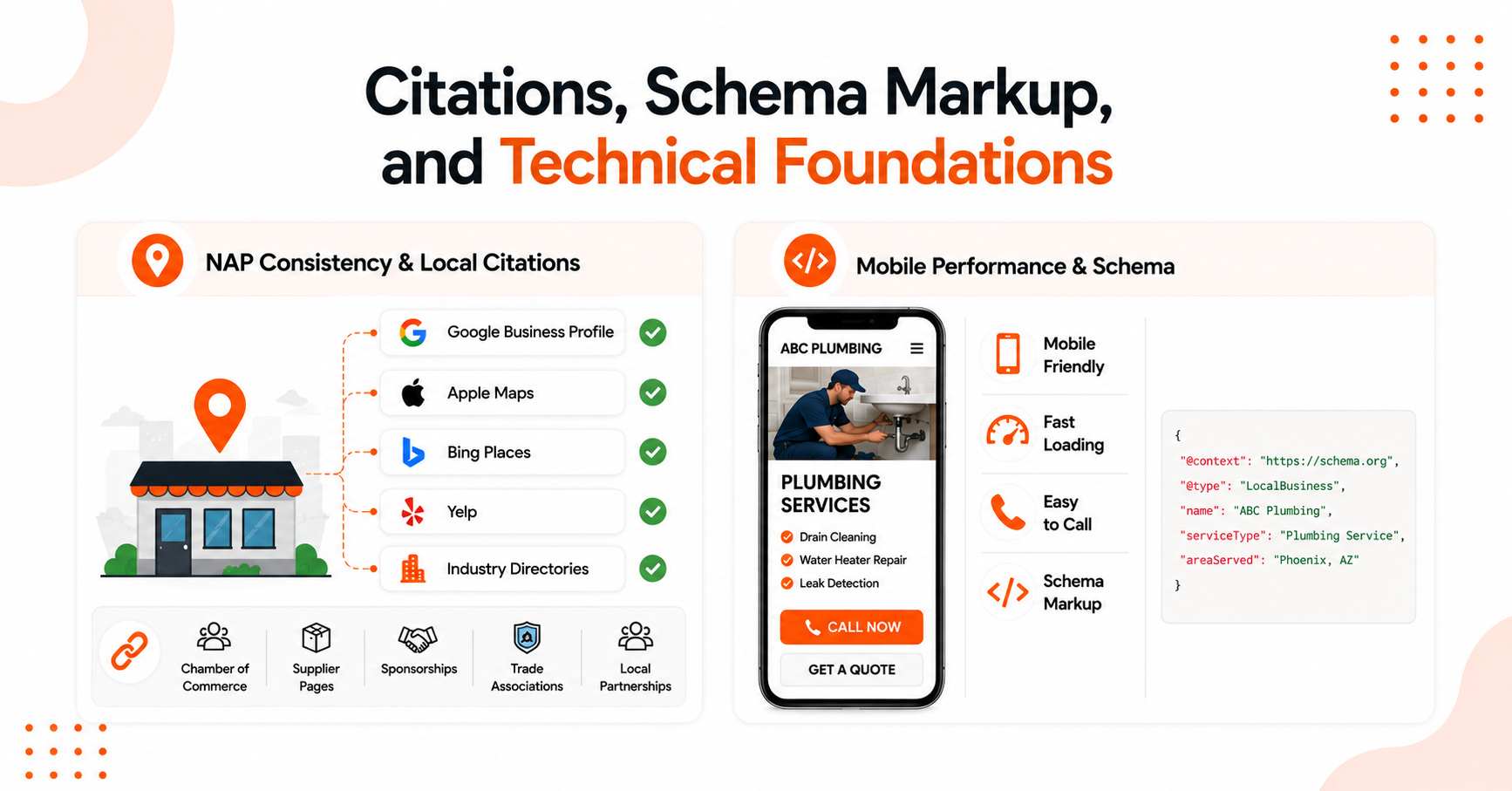
NAP Consistency and Local Citations
Start by conducting a thorough citation audit to identify errors in your business information.
Your business name, phone number, and address need to reflect perfect NAP consistency across the web.
Prioritize consistency across:
- Google Business Profile
- Apple Maps
- Bing Places
- Yelp
- Industry-specific business directories
This uniformity is vital because duplicate listings can confuse search engines and dilute your authority.
When managing your local citations, prioritize accuracy above all else.
Beyond major platforms, look for opportunities to build local backlinks through:
- Chamber of commerce listings
- Supplier pages
- Sponsorships
- Trade associations
- Local partnerships
These links serve as powerful signals that confirm your business is active within your specific market.
Remember that building local citations is a long-term commitment to quality. Periodically check your listings in major business directories to ensure your details remain accurate as you grow.
Mobile Performance and Schema
Your website must function flawlessly on every device.
A mobile-friendly website is no longer optional. It is the baseline requirement for modern service providers.
Ensure that your page loading speed is optimized to meet Core Web Vitals. Also make sure that critical elements like your phone number and inquiry forms are easily accessible.
To help search engines understand your location and service offerings, you must implement proper schema markup.
By adding LocalBusiness schema and relevant service markup to your site, you provide the structured data that helps algorithms connect your services to your specific geographic reach.
While this schema markup is not a replacement for high-quality content, it acts as an essential technical foundation. It helps search engines and AI systems better understand your business information and service areas.
If you want a fast gut check, ask yourself this:
Can a stressed homeowner on a cracked phone screen figure out what you do, where you work, and how to call in under ten seconds?
If not, fix that first.
Prepare for AI Overviews and Answer Engines
Search habits have evolved.
While people still rely on Google, they are increasingly asking full questions and expecting immediate, accurate answers.
This shift impacts service-area businesses more than many realize.
A customer might perform a traditional search for an emergency electrician, but they are just as likely to ask ChatGPT, Perplexity, or Google AI Overviews which company installs EV chargers in their neighborhood, who repairs tankless water heaters, or how much drain cleaning typically costs.
Because of this, your strategy must pivot to address the local intent behind these conversational queries.
Put direct answers high on the page.
A few best practices include:
- Use question-based subheadings
- Add short FAQ sections
- Include pricing ranges when appropriate
- Explain timelines and permits
- Highlight warranties
- Clarify emergency availability
By implementing structured data, you help AI models parse your business information more effectively. This ensures your site provides the precise data required to appear in local search results while supporting AI-driven discovery.
Entity consistency remains vital.
When your business details, reviews, services, and reputation signals align across your site and the wider web, answer engines can better verify your proximity relevance and prominence.
Recent industry standards on AI-driven local search visibility consistently show that clear, data-backed information outperforms vague marketing copy.
Video is another powerful tool for this shift.
YouTube is a massive search engine, and local service questions appear there daily.
A short video explaining how to identify a failed AC capacitor or determine if a roof leak is an emergency can rank independently, support your service pages, and provide a rich media asset that AI can process and trust.
This is the most significant change for 2026.
Your future customers are not just searching. They are asking.
The businesses that win will be the ones that consistently show up with the clearest, most reliable answers.
Track Results and Follow a Monthly SEO Rhythm
A checklist is useless if it sits in a document and nobody touches it again.
Track what happens after the impression.
The metrics that matter most include:
- Profile calls
- Direction requests
- Site clicks
- Form fills
- Booked jobs
- Closed revenue by service type
While monitoring your Google Search Console performance is essential, remember that rankings are nice, but jobs are better.
How Long Does Local SEO Take to See Results?
Local SEO is a marathon, not a sprint.
While you might notice quick wins after implementing technical fixes, building true authority and climbing local rankings usually takes 3 to 6 months.
Consistency is key, especially when you are working to earn local backlinks that signal trust to search engines.
Use Google Search Console to monitor your progress during these initial months, as it provides the data necessary to refine your strategy.
Keep a simple monthly rhythm:
- Review your Google Business Profile, update hours, and upload fresh job photos.
- Ask for reviews, respond to new ones, and look for patterns in what customers keep praising.
- Improve or publish one high-value page and optimize its title tags and meta descriptions.
- Perform a technical SEO audit and check your Core Web Vitals to minimize mobile friction.
- Refine content to better match user intent in your specific service areas.
If you want a quick outside worksheet to compare your setup against, Local SEO Checklist is a solid reference.
And if this has gone past weekend project territory, that is normal.
Once local SEO expands into content, technical fixes, reviews, AI visibility, and video, it becomes real operating work.
FAQs About Local SEO Checklist
Here are additional questions you might ask.
Do Service-Area Businesses Need to Show an Address on Google Business Profile?
No. If customers do not visit your location, you can hide the address and set service areas instead.
You still need a real address for setup and verification of your Google Business Profile, but it does not have to be public if you are a mobile or home-based operation.
What Is the Fastest Local SEO Win for Most Service Businesses?
Cleaning up your presence on Google Maps and implementing a consistent review system are essential. Those two moves often create the fastest lift because they improve both visibility and conversion at the same time.
Do Reviews Help Rankings or Only Conversions?
Both. Generating positive online reviews can support your local rankings, and they absolutely help people choose you over a competitor. Fresh, detailed feedback is much more valuable than a giant pile of outdated entries.
Your Next Customer Is Already Searching
The businesses that win in 2026 are not always the biggest. They are the ones that make it easy for customers and search engines to understand who they are, what they do, and where they work.
Get your Google Business Profile right, build pages that prove your services and service areas, keep reviews coming, and consistently answer the questions your customers are already asking. Over time, those efforts compound into more visibility, more calls, and more booked jobs.
Refresh helps businesses grow through SEO, content, and organic visibility strategies designed to create long-term results. If you are ready to strengthen your local search presence, book a call with us and discover where your biggest opportunities may be!


