
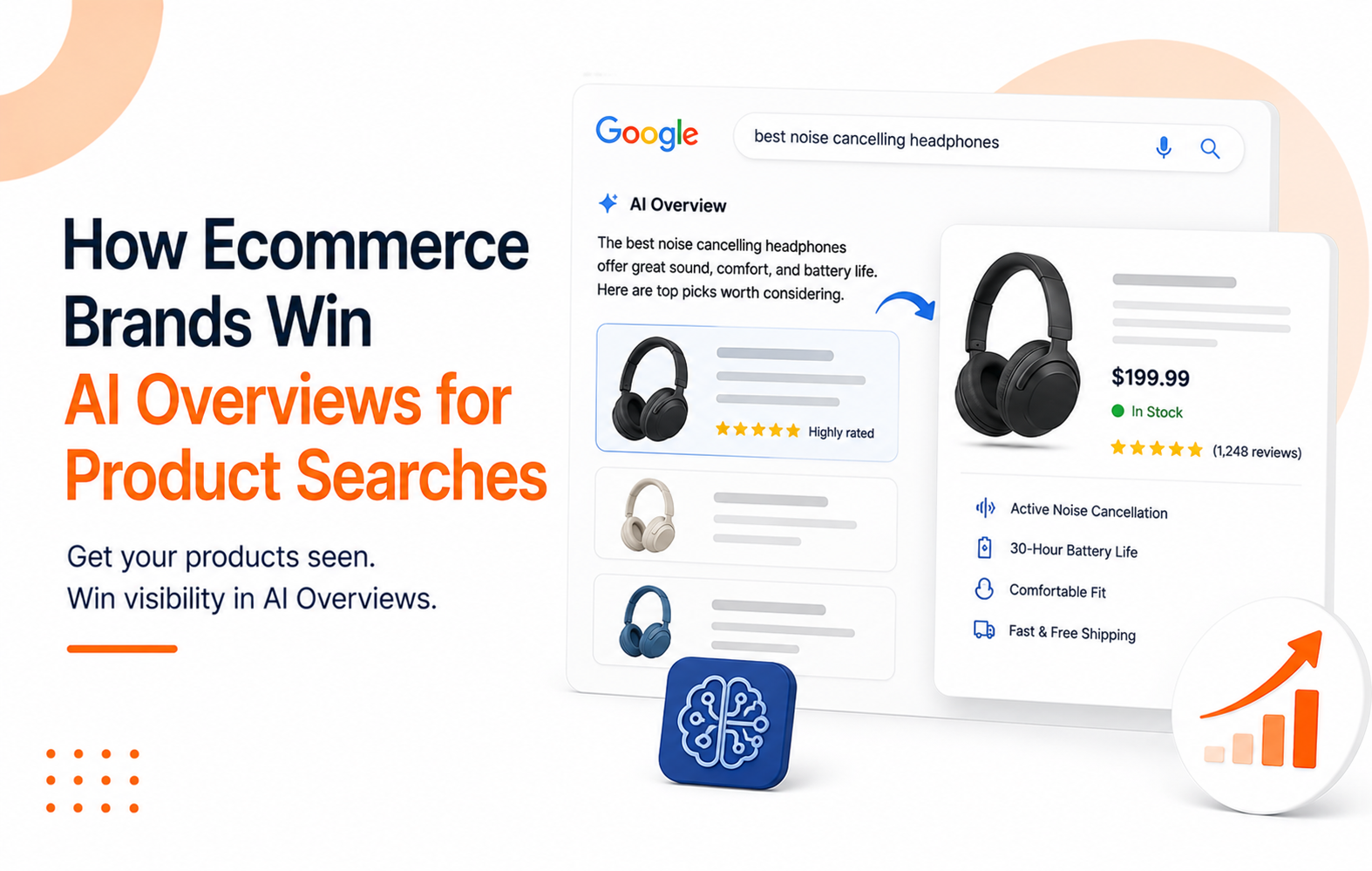
Mastering ecommerce AI overview optimization is now essential for maintaining market share in an evolving search landscape. This guide outlines the strategies that can help your brand earn placement in AI Overviews, recover visibility, and stay competitive in an era of zero-click search.
By aligning your catalog with how machines process information, you increase the chances of your products appearing throughout the consumer journey. The brands that win visibility are often the ones that make their content easier for search engines to understand, trust, and surface.
The product page does not always get the click anymore because Google often answers first. This is a fundamental shift that many ecommerce teams still underestimate.
If your catalog is not built to be parsed by these automated systems, you can lose visibility before a shopper ever lands on your site, compares options, or adds anything to their cart.
The good news is that this process is not random. Brands that win these product query answers usually do a few simple things better, and they do them consistently.
Key Takeaways
- Google favors product and support pages that are easy to read, trust, and quote. If your content is vague, incomplete, or stale, it is more likely to be skipped by AI Overviews.
- Implementing robust structured data is essential. Factors such as price, availability, reviews, high-quality images, and clean product details should align with how shoppers actually search.
- The best page type depends on the query. A product page can win, but so can a category page, comparison page, FAQ, or buying guide, making this a central component of any modern technical SEO strategy.
- Reviews, FAQs, and short answer-first copy help Google pull usable product summaries faster, especially for high-intent searches.
- This is long-game work, not a one-week hack. Unlike paid traffic, strong organic visibility can continue compounding long after the initial optimizations go live.
How Google AI Overviews Change Product Discovery
Shopping search has evolved into an answer layer.
A shopper searches for "best travel mug for hiking" or "silk pillowcase for curly hair," and Google may use generative AI to summarize the options right on the results page. That summary pulls from pages that Google can interpret quickly. Clean facts win, while messy merchandising copy loses.
This matters because these systems are not only looking for a page about a specific topic. They are designed to address conversational queries by evaluating whether a page answers the product question clearly, backs it up with useful detail, and looks trustworthy enough to cite.
Google's own AI optimization guide pushes the same basic idea: make content accessible, machine-readable, and genuinely helpful.
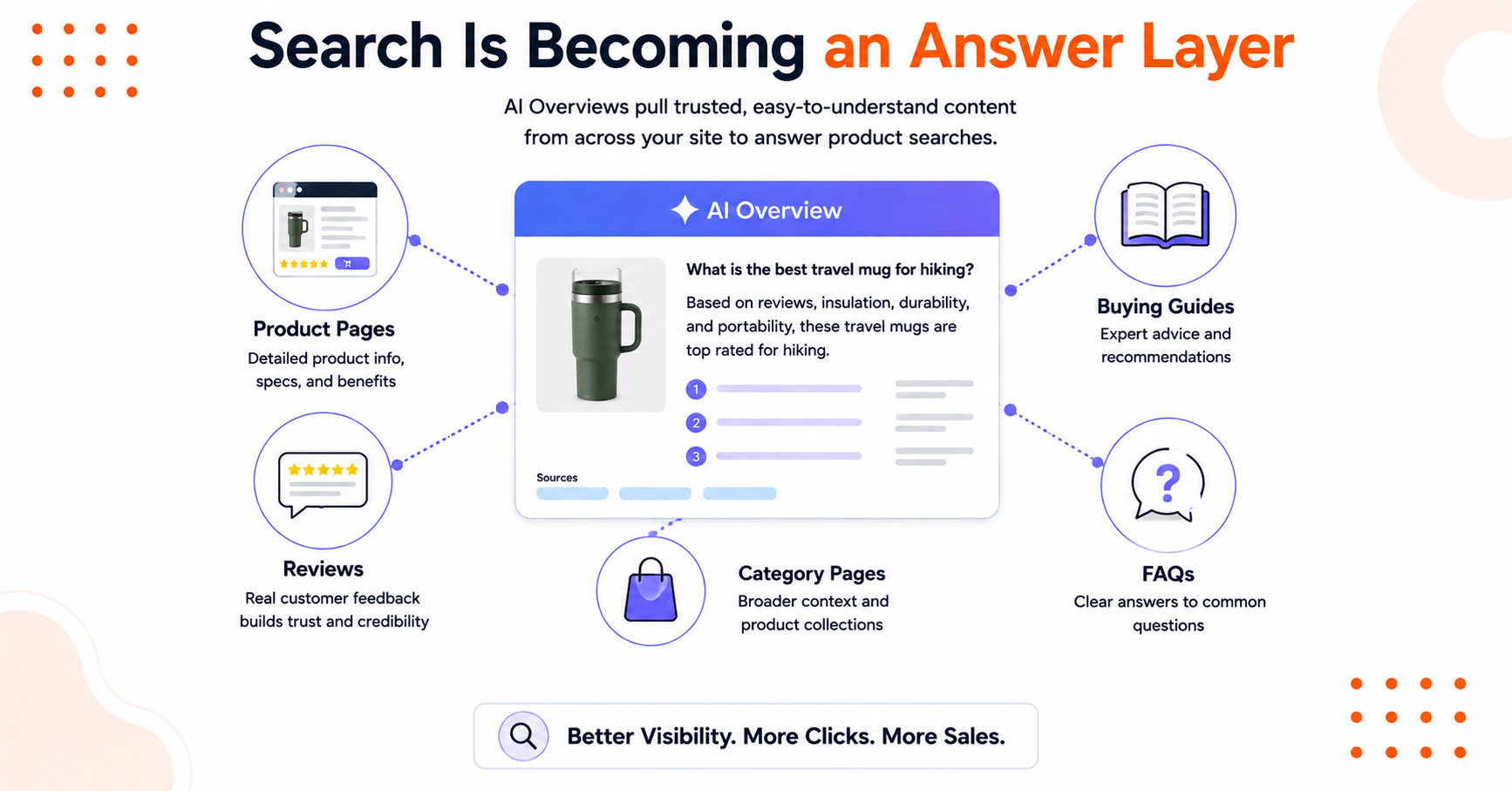
If Google can lift a clean answer from your catalog, you can win visibility before the click in AI Overviews. If it cannot, someone else's page becomes the shortcut.
That changes the job for ecommerce teams. The old playbook was simple: rank the PDP, run Shopping ads, and keep moving.
The new one is broader. Your product page still matters, but now your supporting content, structured data, reviews, and catalog hygiene all affect whether your brand appears in the answer itself.
And here is the part people miss. Winning visibility for product queries is not different from modern SEO. It is the same core work, pushed into a stricter format.
Search needs to understand the exact user intent, identify what the item is, determine who it is for, and explain why it fits the query. By leveraging semantic SEO, you help the engine interpret your product data beyond basic keyword matching to ensure your page remains relevant.
Why Most Product Pages Never Get Cited
Most product pages are built to sell once someone arrives, rather than being built to answer questions.
That is a problem.
A lot of PDPs open with fluffy copy, bury specs, hide shipping details, and treat reviews like an afterthought. Some still have stale prices, thin descriptions, and five nearly identical variant pages competing with each other.
That may limp along in traditional search, but it does not give an AI system much to work with.
Google is trying to reduce uncertainty. When your page leaves basic questions unanswered, it looks risky.
Questions like these should be easy to answer:
- What is the product, exactly?
- Who is it for?
- How is it different?
- Is it in stock?
- Is the price current?
- Are real buyers saying anything useful about it?
If those answers are scattered across tabs, weak copy, and outdated feed data, the page is hard to reuse. That is why a lot of brands with decent authority still do not show up for product-focused results.
The issue is not only backlinks, it is clarity.
Another common miss is inconsistency. The same product gets one name on the category page, another in schema, and a third in review snippets or image filenames.
That is not a small detail; it is friction. Search engines are getting better at understanding entities, but you still do not want them guessing which version is the real one.
Then there is the support content gap. Brands expect the PDP to do everything, even when the query is clearly comparative or educational.
If someone searches "best standing desk for small apartment," a thin product page may not be the right result at all. A tightly built comparison or buying guide can do better because it answers the question directly and then routes the shopper into the right product.
Build Pages AI Can Read, Trust, and Quote
This is where ecommerce teams can make fast progress. You do not need to publish 500 new blog posts. You need cleaner product truth.
By optimizing your Product Detail Pages (PDP) with comprehensive information, you create a foundation that both shoppers and bots can rely on.
Put Structured Data on Every Product Page
Start with product schema. Not sometimes. Not only on hero products.
Every serious PDP needs it. Implementing robust Schema markup is the most effective way to communicate directly with search algorithms.
That includes the basics:
- Product name
- Brand
- Description
- Image
- Price
- Currency
- Availability
- Rating
- Review data when available
Offer details matter because stale or missing price and stock information makes a page look unreliable.
While product schema does not guarantee visibility, it gives Google cleaner inputs. That alone raises your ceiling for AI Overviews.
This is one reason why AI Overviews for product queries often favor merchants with disciplined catalogs. Their pages do not make Google infer everything.
They label it. They update it. They keep it consistent.
To ensure your data is always accurate, utilize Merchant Center Next to monitor your shopping feeds. This helps ensure that the information being processed by generative AI remains consistent with your live site.
Don't stop at markup. Make sure your visible page matches the structured data.
If schema says "in stock" but the page says backordered, that is a red flag. The same applies to pricing mismatches between the page, feed, and merchant listings.
Write the First Answer Fast
The top of the page needs to do more than sound on-brand. It needs to answer the shopper's main question fast.
A good opening block usually explains:
- What the product is
- Who it is for
- The main reason to choose it
Keep it tight. If you are targeting product-style answer boxes or AI citations, a 40 to 60-word summary often works better than a long intro that wanders.
Think about how real people search. They do not ask for "premium hydration innovation."
They ask whether the bottle fits in a cup holder, keeps water cold, or survives a hiking trip. Your page should answer those questions with direct language.
That means adding concrete details like:
- Material
- Size
- Compatibility
- Fit
- Skin type
- Battery life
- Scent profile
- Storage
- Care instructions
Whatever actually matters for the product.
The more specific the page, the easier it is for Google to match it to a specific query.
The same goes for images. Use sharp images with descriptive alt text and filenames that reflect the product and context. Image understanding is part of product understanding now, not a side quest.
Strengthen Brand and Offer Signals
AI systems do not only read the product block. They read the business around it.
Transparent shipping and return policies help. So do contact details, warranty information, brand story pages, author or expert contributions where relevant, and consistent naming across the catalog.
If your supplement brand, skincare line, or gear company has real expertise behind the products, make that visible.
Reviews matter here too, but not only the star average.
What matters most includes:
- Freshness
- Depth
- Specificity
A page with recent, detailed buyer feedback is easier to trust than one with twenty vague five-star blurbs from 2023.
This is also where broader answer-engine work starts to overlap with ecommerce SEO. The same structured, entity-clear content that helps you show up in Google answers can support visibility across other AI surfaces too.
If you are building for search, AI, and discoverability at the same time, Refresh's AEO and video marketing strategy is built around that exact shift.
Match the Query to the Right Page Type
Not every product query should land on a PDP. Understanding user intent is essential here, as aligning your content with the specific way shoppers search helps you capture everything from transactional clicks to informational keywords that signal early-stage research.
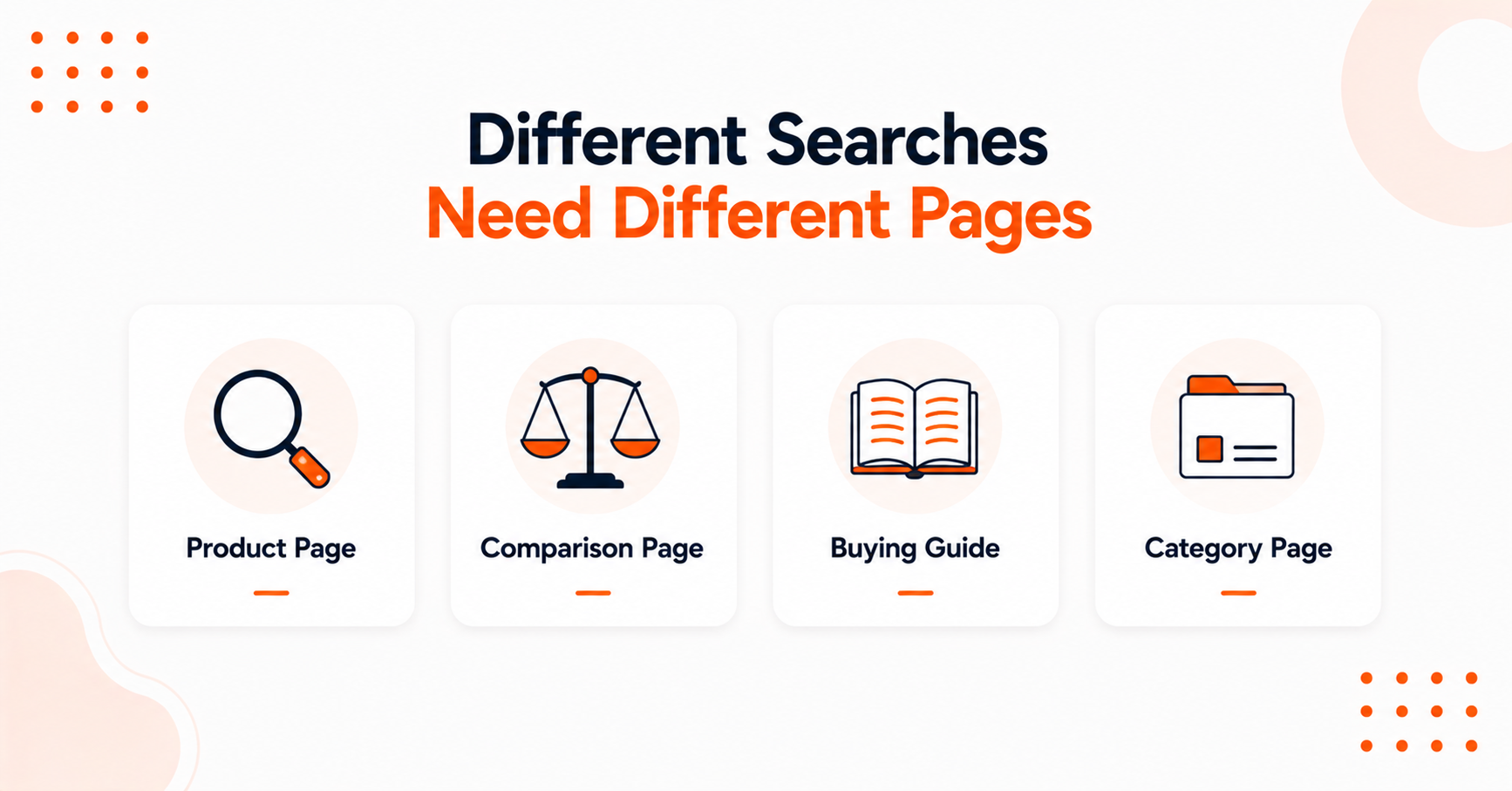
This is where smart merchandising beats brute-force optimization. Different searches call for different page formats, and generative AI is increasingly skilled at identifying which page type best satisfies the user.
The takeaway is simple: stop forcing every search into the same template.
Category pages can win when the shopper wants a filtered set of options. Buying guides can win when the search has a clear problem to solve.
Comparison pages can win when the query is about tradeoffs. Product pages can absolutely win too, but usually when the search intent is close to purchase or tied to a precise feature.
A strong ecommerce content system covers all of those angles. That is how visibility compounds.
You are not publishing random support pages. You are building the exact assets Google needs for different types of product questions.
Reviews, FAQs, and Fresh Merchandising Signals
If structure is the skeleton, reviews and FAQs are the proof.
Product queries in AI Overviews often pull from pages that answer practical buyer questions better than the average merchant does.
Modern natural language processing allows generative AI to sift through customer feedback and extract specific, helpful answers that resolve shopper intent. These sections act as essential citation signals, confirming for AI Overviews that your content provides the authoritative, real-world context users are looking for.
Avoid fake filler content. Instead, use actual questions from:
- Support tickets
- Reviews
- On-site search
- Pre-purchase chats
For a stroller, that might be "Does it fit in a trunk?" For cookware, "Is it induction-compatible?" For apparel, "Does it run small?"
These are the questions that move shoppers from curiosity to confidence.
Put the question in a heading. Answer it right away. Then add a little proof, context, or edge-case detail below.
That format is easy to read and easy for Google to lift. Fresh reviews help for the same reason. They add current language, current use cases, and current trust.
Keep your merchandising signals fresh too. Price, stock, shipping speed, bundle details, and variant availability should not lag behind reality.
If your product page still says "limited stock" three weeks after the item sold out, the whole page starts to feel suspect.
This is the boring part of the job. It is also the part that wins.
How to Measure What Is Working
Don't treat AI Overview visibility like a trophy screenshot. Treat it like a growth asset.
Start with the pages that already earn non-brand impressions and sit close to the top results. These are often the easiest wins.
If Google already trusts the page enough to rank it, better structure and stronger answers can push it into citation territory.
To track your progress, rely on Google Search Console to monitor keyword performance and Merchant Center Next to keep your product data accurate.
Keep a close watch on:
- Target queries
- Ranking position
- Organic traffic
- Page-level conversions
- Review freshness
- Whether the page appears in AI-generated search summaries
Pay attention to the answer format Google prefers. It might favor a short paragraph in some cases or a comparison-style layout in others.
Also, look at assisted revenue rather than only direct last-click sales. A category guide or FAQ page may influence conversions even if it doesn't close them.
That is still a win.
Finally, keep expectations sane. Some pages move quickly after technical fixes or better answer blocks.
However, bigger gains usually come after you have cleaned up your page structure through rigorous technical SEO, improved internal linking, and refreshed stale product detail pages across the entire catalog.
That is how this channel compounds. Paid traffic stops when the spend stops, but owned product visibility keeps working.
FAQs About AI Overviews for Product Queries
Below are additional questions you might ask.
Do Product Pages Really Win AI Overviews, or Do Guides Work Better?
Both can win AI Overviews. The best page type depends on the search intent.
If the query is close to purchase, a strong product page often makes sense. If the query is comparative, use-case driven, or problem-first, a buying guide, comparison page, or category page may be a better fit.
The goal is to match your content to the user intent. For many brands, success in AIO depends on providing high-quality answers that satisfy the user immediately without requiring additional clicks.
Is Schema Markup Enough on Its Own?
No, schema markup is not enough on its own. Schema helps AI crawlers understand the page, but it does not rescue weak content.
You still need clear copy, current offer data, useful reviews, and a page structure that is easy to quote. Think of schema as a translation layer that helps you earn rich results; it helps, but it cannot fix a confusing product page by itself.
To truly gain an edge, your content must demonstrate high levels of E-E-A-T, proving to search engines that your brand is a trusted authority in your niche.
How Long Does It Take to See Movement?
It varies by site quality, crawl frequency, and how competitive the query is. Some product pages improve quickly after you fix structured data, answer blocks, or stale details.
Because the Gemini language model processes data differently than traditional search algorithms, results can shift as the model updates its understanding of your catalog. Broader gains usually take longer because they depend on consistency across many pages.
This is medium-term work, and that is exactly why it compounds.
What Should Ecommerce Teams Fix First?
Start with the pages already closest to winning. High-impression product and category pages often provide the fastest opportunities for improvement.
Look for weak copy, thin specs, old reviews, missing FAQs, or incomplete schema. Clean those up first to better cater to generative AI and its tendency to pull from comprehensive, accurate information.
Then move into comparison content, supporting guides, and broader catalog consistency. That is usually the fastest route to better visibility for AI-driven product searches.
Need Help Building Content for AI-Powered Search?
The brands that win product visibility in AI search are not stuffing pages with more copy. They are making their catalogs easier for machines to understand through clear structure, complete product data, direct answers, and content that matches search intent.
As AI Overviews continue to reshape product discovery, visibility depends on more than just rankings. Your content, product pages, reviews, and supporting resources all play a role in helping search engines understand and surface your products.
Refresh is an organic growth marketing agency that helps brands improve visibility across search, off-site visibility opportunities, ChatGPT Shopping, and Perplexity Shop. If you want help strengthening your ecommerce search presence, schedule a call today.


