
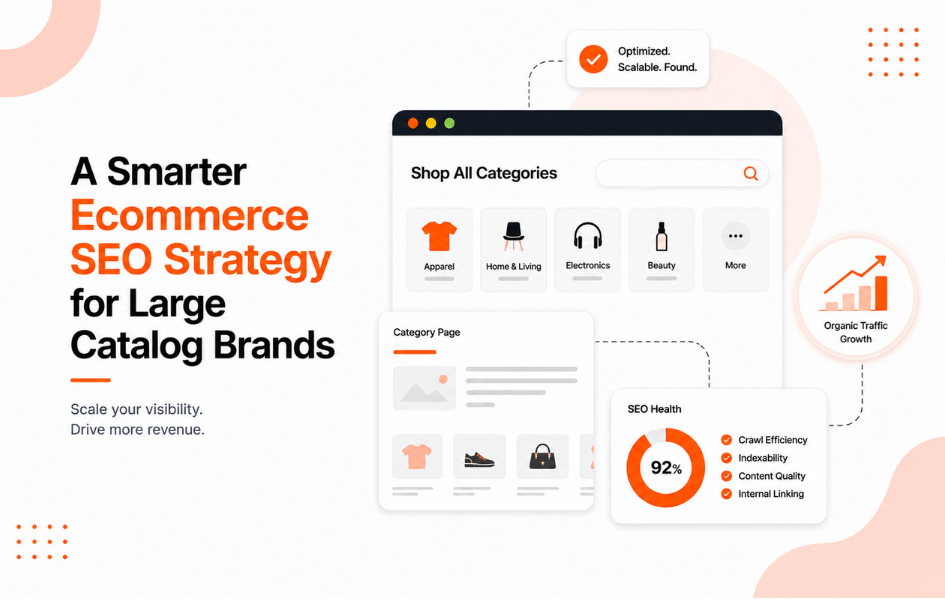
A large product catalog can make your store look robust and authoritative while still leaving it virtually invisible to potential customers.
When thousands of URLs pile up, search engines do not automatically see an opportunity for growth. Instead, they often encounter duplication, wasted crawl budget, and mixed signals that prevent your site from capturing the organic traffic it deserves.
That is why a serious ecommerce SEO strategy for a large catalog must be built on scalable systems rather than one-off page edits.
Key Takeaways
- Large catalogs win when category pages act as the foundation for your overall ecommerce SEO strategy.
- Mastering technical SEO is just as critical as on-page optimization for managing expansive product databases.
- Strong, scalable templates produce more consistent results than relying on random manual fixes.
- Not every filter, product variant, or low-value page deserves to be indexed by search engines.
- Long-term success requires alignment between your content efforts and the specific search intent of your customers.
- The most effective SEO programs prioritize resources based on potential revenue rather than total URL count.
Start With Architecture, Not More Pages
Most large ecommerce sites do not have a content problem. They have a site architecture problem.
Your category pages should function like commercial landing pages, crafted around rigorous keyword research to ensure they meet user intent. They need a clear purpose, clean URLs, strong internal links, and copy that helps shoppers narrow the field. If those pages are thin, buried, or cannibalized by filter URLs, rankings stall fast.
Every product should sit inside a simple hierarchy. No weird detours. No five different paths to the same item. Search engines still use site structure as a major clue, and shoppers do too.
That means fewer orphan pages, fewer internal dead ends, and more effective internal linking that pushes authority into the pages that can actually rank. A clean architecture also makes future growth easier. Add a new collection, brand, or season, and the site still makes sense.
Here is the simple test: if a new team member cannot explain your category structure in two minutes, it is probably too messy.
Protect Crawl Budget and Control Duplicate URLs
This is where large catalogs go sideways, and where sound technical SEO becomes a necessity.
Filters, sort orders, color variants, pagination, session parameters, and duplicate category paths can turn one product into a pile of near-identical URLs.
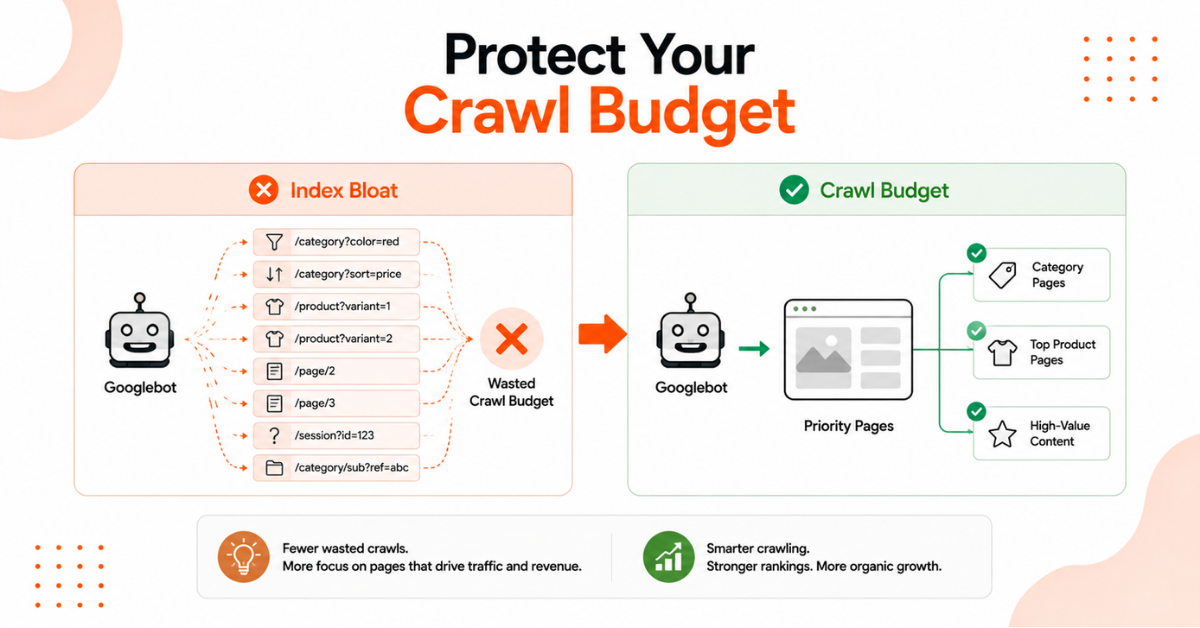
Common causes of index bloat include:
- Filter combinations
- Sort-order URLs
- Product variants
- Pagination issues
- Session parameters
- Duplicate category paths
Search engines waste time on these variations, which means your priority pages receive less attention. If you allow this index bloat to continue, you will inevitably experience a drop in organic traffic.
Large-catalog SEO is a prioritization problem first, and an optimization problem second.
Use canonical tags where duplicate versions need to exist. Use noindex directives when a page helps users navigate your site but should not compete in search results.
Keep faceted navigation indexable only when the filtered result matches real user demand and maintains enough stable inventory to deserve a dedicated landing page.
Split your XML sitemap by page type to improve crawl efficiency. Monitor your performance in Google Search Console, and if you have the resources, review your server logs.
You want search bots spending their time on your money pages, not on junk URL combinations.
That matches the thinking in these scalable enterprise ecommerce SEO tactics. The big idea is simple: treat scale like a systems challenge, not a page-by-page checklist.
Build Templates That Scale Without Feeling Thin
You do not need handcrafted copy for 80,000 SKUs. You do need a strong template.
Product Page Templates
For product pages, that means moving beyond basic specs to create high-quality product descriptions.
A scalable template should consistently include:
- Optimized title tags
- Meta descriptions
- Image alt text
- Schema markup
- Structured data
When possible, add differentiators buyers care about, such as sizing guidance, compatibility notes, materials, care instructions, or shipping details.
Beyond text, remember that your pages must remain mobile-friendly and meet Core Web Vitals standards to ensure a seamless experience.
Category Page Templates
Category pages need templates too.
Give them room for:
- A short introduction
- Featured brands
- Common use cases
- Internal links to top subcategories
- Supporting FAQ content
By incorporating user-generated content like customer reviews, you add social proof that helps both rankings and conversions.
Furthermore, syncing your product data with Google Merchant Center is essential to maximize your visibility across search surfaces.
Prepare for AI-Driven Search
This is also where 2026 search looks different.
Google's AI Overviews and answer engines pull directly from trustworthy, structured data. If your pages are vague or missing key attributes, they get skipped.
Brands that win long-term do not just rank individual pages. They show up where customers ask questions and get instant answers.
A solid template turns SEO into an asset. Paid traffic stops when the budget runs out, but a well-built catalog continues to drive results long after the work is done.
For a broader look at how that plays out in online retail, this guide on how SEO affects ecommerce growth is worth a read.
Prioritize by Revenue, Not by URL Count
Now the strategic part.
Not every page deserves the same effort. If your team treats a low-margin product and a top category the same way, you will stay busy and move slowly.
That is not a growth plan. That is churn.
Create SEO Priority Tiers
Start by tiering your site.
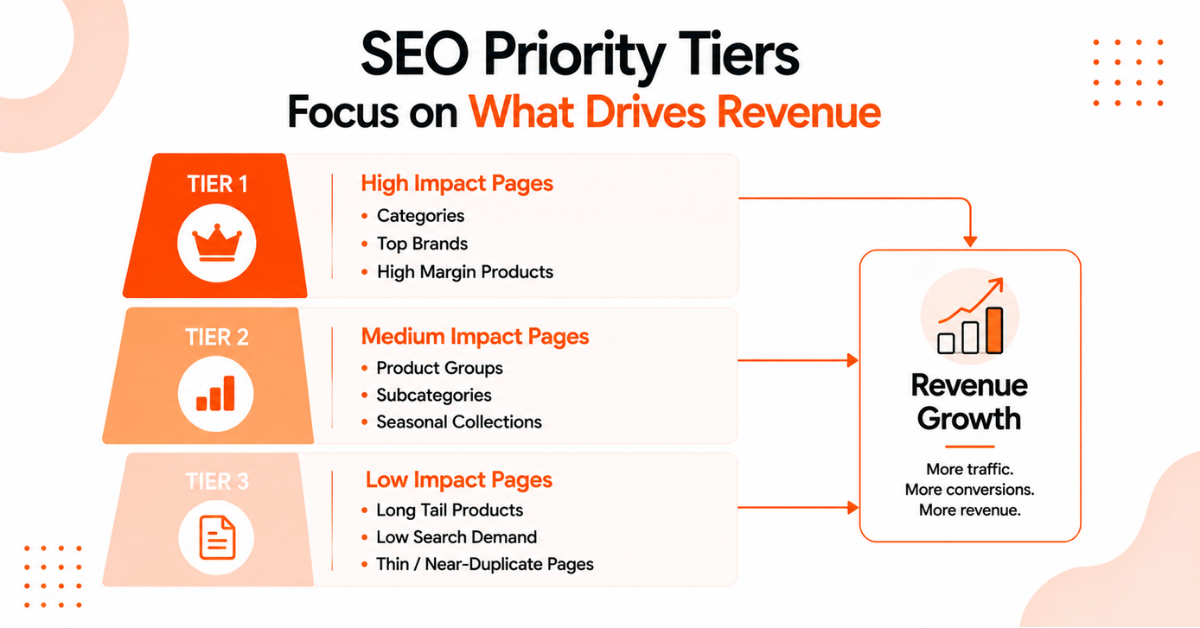
Tier 1 pages typically include:
- Core category pages
- Top brands
- Highest-margin products
- High-intent informational pages
These Tier 1 pages should be carefully aligned with search intent and high-volume keywords identified during your keyword research.
Because these pages are vital for your bottom line, they require a dedicated link building strategy to earn high-quality backlinks that boost authority and improve your store conversion rate.
Lower-value pages can rely more on templates and rules.
Align SEO With Merchandising
Merchandising and SEO need to stay tied together here.
If a product is seasonally out of stock, keep the page live when demand will return. If it is gone for good, redirect it to the closest replacement or category page.
Do not leave dead ends everywhere and call it site maintenance.
The brands pulling ahead are not always spending more. They are building a stronger organic engine, one that compounds over time and keeps showing up across search and AI-driven results.
FAQs About Ecommerce SEO Strategy
Below are additional questions that might help you.
How Many Product Pages Need Unique Copy?
Usually not all of them.
Prioritize writing custom copy for high-demand, high-margin, or hard-to-differentiate product pages first. For the rest of your catalog, use better templates, richer data fields, reviews, and structured markup.
This approach allows you to scale efficiently while still targeting specific long-tail keywords that drive qualified traffic to your site.
Should Filter Pages Be Indexed?
You should only index filter pages when the resulting view matches verified search demand and remains useful for users over time.
Deciding which pages to include in the index should be a core component of your ongoing SEO audit. Most filter combinations should remain excluded from search results so they do not crowd out your primary category pages or dilute your site authority.
What Should You Measure First?
Start by tracking non-brand organic revenue, category page visibility, and indexation quality.
You should also use keyword research to monitor SERP performance for specific title tags and meta descriptions across your highest-value page groups.
While rankings are a useful signal, tracking revenue by template type provides the clearest indication of whether your strategy is delivering a tangible return on investment.
Ready to Build a Stronger Ecommerce SEO Strategy?
A massive catalog is not an SEO advantage by default. It is raw material.
The brands that win turn that sprawl into structure, crawl rules, strong templates, and ruthless prioritization. By organizing your catalog effectively, you position your brand to dominate the SERP and capture high-intent searchers.
Do that well, and organic growth starts to compound, providing a sustainable source of organic traffic that does not reset every month like paid advertising campaigns.
Refresh helps brands turn complex catalogs into scalable SEO systems. If that sounds like the challenge you are facing, schedule a call to explore your next steps.


