
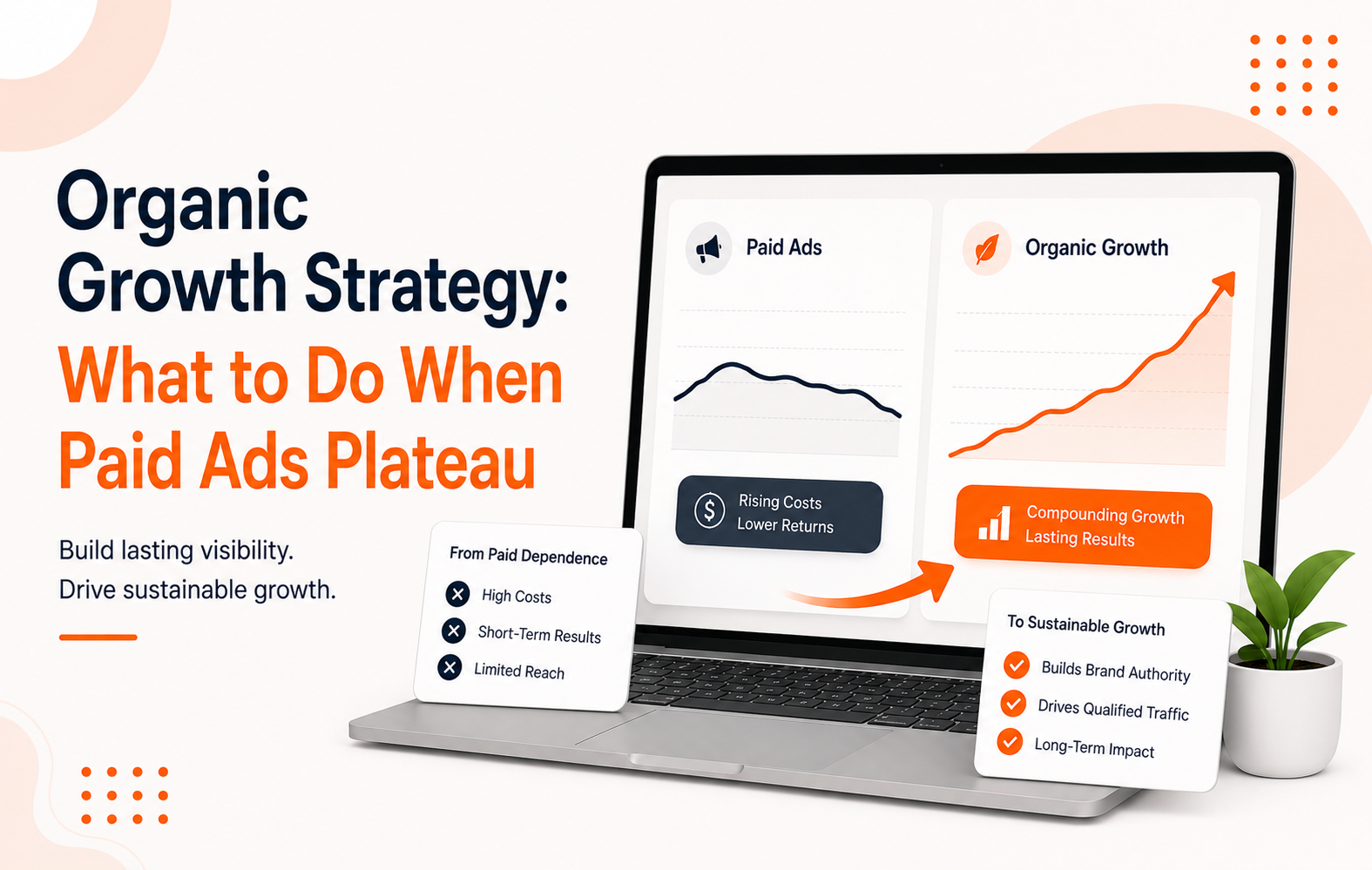
Paid ads are great until the math stops getting prettier. CAC creeps up, ROAS gets tighter, and each new dollar starts working harder for less.
That does not mean your brand is broken. For many high growth firms, it simply means the next stage of sustainable growth requires assets that continue creating visibility, trust, and demand beyond paid media.
Making this shift often requires a change in company culture. Strong digital marketing systems are built around serving a specific target audience consistently, not just chasing short-term campaign performance.
Key Takeaways
If your paid program has flattened out, here is the short version:
- Paid ads capture existing demand, but they do not always create enough new demand on their own.
- Organic growth compounds through content, search visibility, AI answers, video discovery, and branded demand.
- Modern digital marketing visibility extends beyond Google rankings to platforms like ChatGPT, Perplexity, Google AI Overviews, and YouTube.
- Strong organic systems are built through structure, consistency, and a deep understanding of your target audience.
- Sustainable growth comes from building assets, not just buying attention.
Keep that frame in mind as you read. You are not replacing one channel with another. You are building an asset.
Why Paid Ads Plateau
Paid media usually does not fail all at once. It gets more expensive and less forgiving. Then one day you realize the team is working twice as hard to squeeze out the same result.
A lot of brands do not have a product problem at this stage. They have a discoverability problem. The people who are ready to buy right now might already know you, have clicked before, or have seen the same creative too many times.
So your campaigns start circling the same pool.
That pattern lines up with recent thinking on the growth plateau and brand awareness. Once performance channels saturate existing demand, more spend often delivers smaller gains.
You are still capturing demand, but you are not creating enough of it. Unlike inorganic growth, which often relies on external injections like mergers and acquisitions or heavy ad spend to inflate numbers, organic methods utilize existing resources and internal resources to build value from within.
Paid media rents attention. Organic visibility builds an asset.
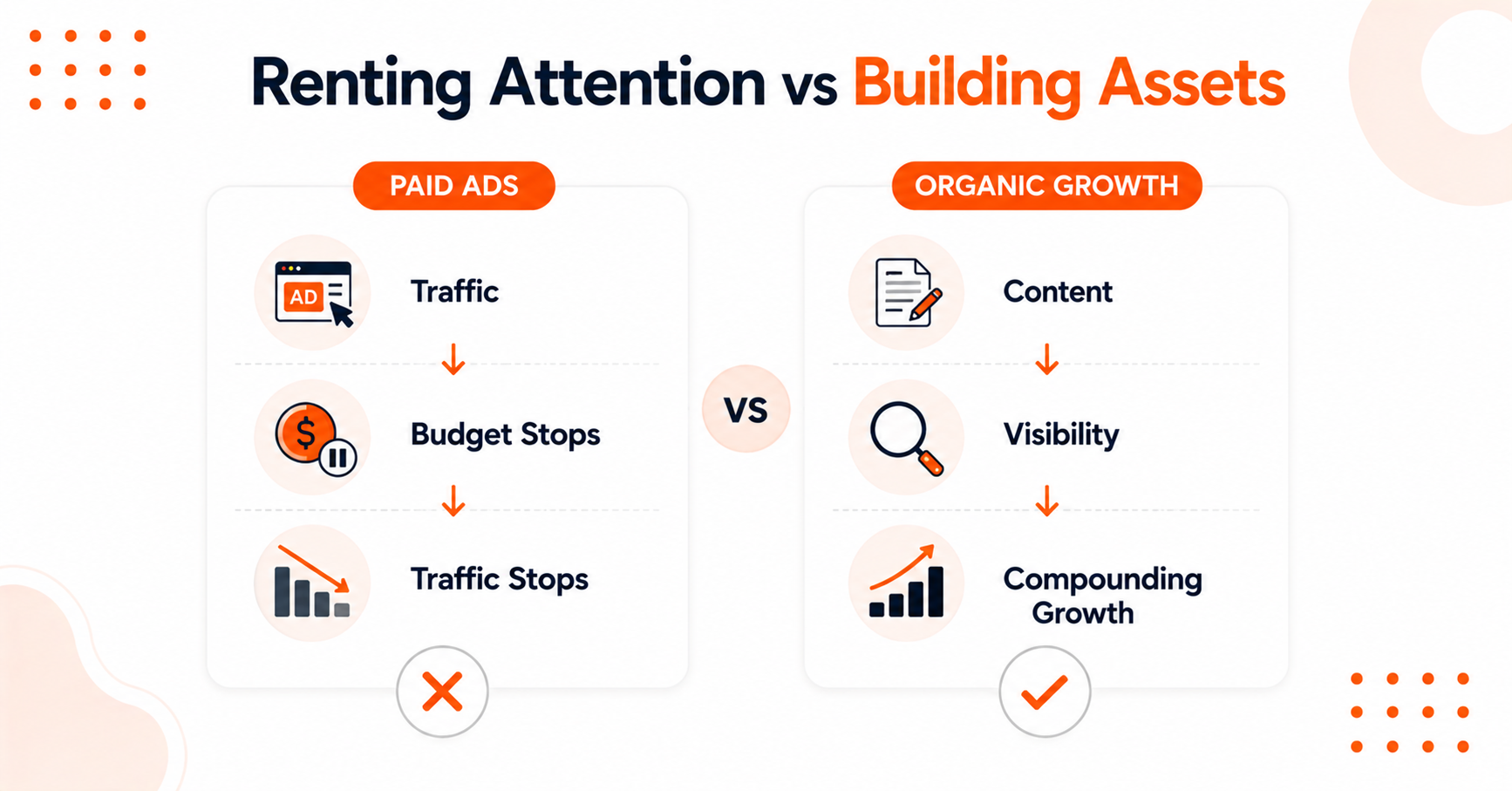
That is the big distinction. Paid is a faucet. Turn it on, traffic flows. Turn it off, it stops.
Organic is slower at the start, but each page, video, answer, and mention keeps working after it is published. Over time, that stack of assets starts doing real work for you.
This is also why going all-in on paid after a plateau often backfires. You do not need more pressure on the same channel. You need more surfaces where buyers can find you, trust you, and come back on their own.
Moving From Capturing Demand to Creating It
Here is the shift: stop asking only, "How do we buy more clicks?" Start asking, "How do we become the brand people find before they are ready to click an ad?"
That is how growth opens back up.
People do not only search the old way anymore. They ask full questions in ChatGPT. They compare options in Perplexity.
They scan Google's AI Overviews before they ever touch a blue link. If your brand is not part of those answers, you disappear early, before the buying conversation even starts.
So what creates demand? It starts with thorough market research to identify exactly what your audience is asking.
Once you have those insights, you can:
- Build useful content
- Create strong category and product pages
- Publish comparison guides that speak directly to a niche market
- Highlight your unique differentiators through video demos, tutorials, and buyer education
This helps build an audience that remembers you when the problem shows up next month, not only today.
A simple look at organic growth vs paid ads makes the same point clearly: paid gets distribution fast, while organic builds trust and discoverability that last longer.
For mature SaaS, DTC, and ecommerce brands, that is even more important because the easy paid wins are usually gone already.
The good news is that demand creation is not vague brand fluff. It is operational.
You publish content around real questions uncovered in your research. You build pages around specific use cases. You show up for comparisons, setup problems, pricing questions, and category terms.
Then you keep improving what starts to rank, what gets cited, and what assists conversions.
Now you are not waiting for the next paid optimization trick. You are expanding how the market finds you.
Building a Self-Sustaining Organic Growth Strategy
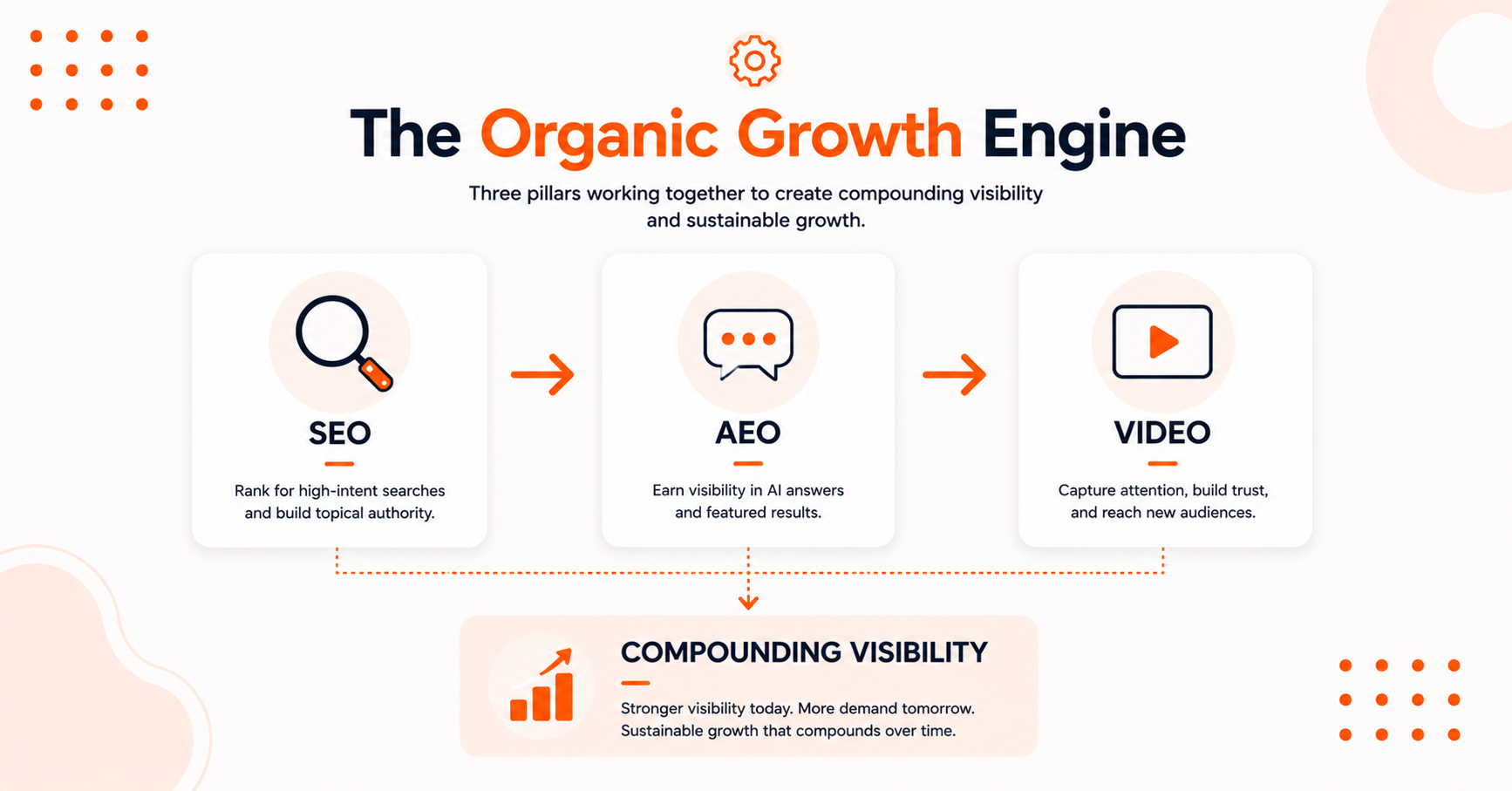
The strongest post-plateau strategy usually has three working parts:
- Search
- Answer visibility
- Video
Not one or the other. All three, tied together.
Buyers rarely move in a straight line anymore. They search, watch, compare, ask AI, come back, and search again.
Modern SEO Still Does the Heavy Lifting
SEO still matters. A lot. But modern SEO is not about publishing random blog posts and hoping a keyword sticks.
It starts with structure. Clean technical foundations. Clear site architecture.
Topic clusters that show depth. Internal links that connect related pages. Refreshes for older content that is slipping.
Pages that answer a question fast, then prove the answer with detail. When you refine these elements, your site gains a distinct competitive advantage in the search results.
This is also where semantic SEO and entity clarity start pulling their weight. Search engines do not only match keywords now. They try to understand what your brand, products, and pages actually are.
If your naming is messy, your pages are disconnected, or your product language changes every five minutes, you make that job harder.
Schema helps. FAQ markup still helps.
So do clean headings, short definitions, comparison tables, and direct answers near the top of the page. For many question-led searches, a tight 40 to 60 word answer under a clear heading gives Google and AI systems something easy to lift.
If you want to see how those pieces fit together in practice, Refresh's organic growth and SEO services lay out the mix of SEO, AEO, and video that drives compounding visibility.
AEO Puts Your Brand in the Answer
Answer engine optimization, or AEO, is the next layer. Search is turning into an answer layer. That is the real change.
If your brand is not part of the answer, you are invisible earlier in the journey.
AEO means building pages and brand signals that machines can trust and extract. That includes direct question-and-answer formatting, strong entity signals, consistent company and product descriptions, trusted mentions across the web, and content that matches the language buyers use when they ask full questions.
This is also why featured snippets, AI Overviews, and answer engines overlap so much. Clear structure helps all of them.
So does authority. So does saying one thing plainly instead of burying the answer halfway down the page.
Video Creates Discovery and Trust
YouTube is still the second-largest search engine, and most brands still treat it like a side project. That is a miss.
Video is where trust gets built fast. A good demo, tutorial, teardown, or comparison can rank, get shared, and assist conversions long after publish day.
It also gives you assets to reuse across email, product pages, social clips, and sales follow-up. For brands in professional services or a specific niche market, video content is an essential way to humanize your expertise.
Furthermore, the comments and engagement on these videos often act as an informal product development feedback loop, helping you understand what your audience actually wants to see next.
The best brand videos do not open with a logo animation and a slow intro. They open with the problem, the audience, and the payoff.
Then they show the product. Fast.
For software brands, that might be a setup guide or workflow tutorial. For DTC and ecommerce, it might be a product comparison, use-case demo, or "why choose this over that" explainer.
Either way, the rule is the same: lead with the buyer's question, not your internal feature launch.
How to Reallocate Budget Without Breaking Pipeline
Don't panic and cut your paid budget. That is the wrong move for most brands.
Keep the campaigns that still produce. Brand search, high-intent retargeting, top-performing acquisition pockets, and launch support often deserve to stay.
Cut the campaigns you keep defending only out of habit.
A hybrid model usually wins here. Paid keeps short-term demand moving, while organic builds the system that lowers your dependence on inorganic growth over time.
This basic hybrid strategy tends to outperform all-or-nothing channel bets by creating a sustainable foundation for long-term revenue generation. This approach is particularly effective for professional services firms looking to stabilize their pipeline as they transition away from ad-dependent tactics.
A phased approach keeps the transition practical while supporting overall business expansion:
TimeframeKeep Paid Focused OnBuild OrganicallyFirst 90 DaysBrand search, retargeting, proven campaignsTechnical fixes, content map, conversion pagesMonths 3 to 6Efficient acquisition pocketsTopic clusters, FAQ pages, comparison pages, YouTube libraryMonths 6 to 12Launch support and remarketingContent refreshes, AI answer visibility, branded demand
The mistake is funding organic with leftovers. If it only gets the scraps, it never gets enough momentum to matter.
Give it real resources, real ownership, and a clear scorecard.
And if your in-house team is already stretched, that is usually the moment to think seriously about how to scale with an organic growth agency.
Not because an agency is magic, but because compounding channels require consistent, expert execution.
What to Measure in the First 12 Months
If you only track traffic, you will either get false confidence or false panic.
A better scorecard has leading indicators and business outcomes side by side.
Early on, look for non-brand impressions, ranking movement on target pages, snippet wins, stronger branded search, watch time, and pages getting indexed and cited.
Those numbers tell you the machine is starting to turn. Then, tie that to outcomes that matter. Track demo requests, trial starts, and email signups.
Pay attention to revenue assisted by organic sessions, product page conversions from non-brand traffic, and video views that lead to site visits.
Beyond acquisition, include metrics related to existing clients to understand how your organic content supports customer retention. Evaluating the overall customer experience helps ensure your strategy is nurturing existing customers as well as attracting new ones.
For AI and answer visibility, measurement is still a little messy. That is fine.
Use a fixed set of prompts. Check whether your brand appears. Track referrals when they show up. Watch which pages get pulled into search features and protect those pages once they win.
One more thing: refreshes matter. If a page climbs to page one or wins a snippet, do not leave it alone for a year.
Update it. Strengthen internal links. Expand supporting content around it. Organic gains stick better when you defend them.
The point is not to collect pretty dashboards. The point is to see whether your organic system is reducing paid dependency while growing pipeline.
The Mistakes That Keep Brands Stuck
The first mistake is expecting paid-speed results from organic work. That is how teams quit too early. Organic growth usually starts showing real traction in months, then compounds after the content base, links, and internal structure begin reinforcing each other.
This transition requires a company culture that values long-term compounding over immediate gratification, as impatience often kills potential success before it has a chance to flourish.
The second mistake is publishing disconnected content. More posts do not equal more growth. If the site feels like a pile of one-off ideas, search engines and buyers both have to guess what you do best.
Furthermore, even if your content strategy attracts high-quality traffic, failing to provide excellent customer service can undermine the trust you worked so hard to build, causing potential leads to look elsewhere.
The third mistake is boxing SEO, AEO, and video into separate silos. They work better together. A strong article can power an AI answer, feed a sales page, become a video script, and earn internal links from related pages.
The fourth mistake is obsessing over rankings without asking whether the right people are finding the right page. Ranking for a broad query that never converts is not a win. It is noise.
Most brands do not need more content. They need a tighter system.
FAQs About Organic Growth Strategy
Below are the related questions you might ask, too.
How Long Does an Organic Growth Strategy Take to Work?
Most brands start seeing early traction in 3 to 6 months if the work is focused and consistent. While inorganic growth through paid media provides an immediate spike in traffic, organic results are slower to materialize but offer much better long-term stability.
The bigger payoff usually shows up after that, once topic clusters, internal links, refreshed content, and video assets start reinforcing each other. Some pages move fast, but the real win is the compounding effect.
Should We Cut Paid Ads Once Organic Starts Working?
No, you usually should not cut paid ads once organic starts working. Paid still has a strong job to do, especially for launches, remarketing, branded demand capture, and proven acquisition pockets.
The goal is not to replace paid with organic. The goal is to stop being over-dependent on paid for every lead, every visit, and every month of growth.
What Content Should We Publish First After a Paid Plateau?
Start with bottom-of-funnel and high-intent content. That means product comparisons, category pages, use-case pages, pricing questions, setup guides, buyer FAQs, and video demos.
Go where purchase intent already exists. This approach is equally valuable for existing clients, as helpful content can deepen their trust and eventually increase your share of wallet.
Once you have those foundations, build out the mid-funnel education that creates more demand around those money pages.
Does AI Search Change the Strategy?
Yes, AI search changes the strategy, but it does not replace the basics. Clear structure, strong brand signals, direct answers, entity clarity, and trusted mentions matter even more now.
If someone asks ChatGPT or sees a Google AI Overview, your brand needs to be easy to understand and easy to cite. Good SEO now supports answer visibility too.
Can an In-House Team Do This Without Outside Help?
Yes, an in-house team can do this without outside help if strategy, content, technical SEO, web, and distribution are all aligned. That is the hard part.
Many teams have the talent but not the bandwidth or ownership model to execute consistently. Success often depends on whether the team leverages external advisory services to provide expert guidance and ensures that their content strategy is fully integrated with their customer service department.
When these areas are aligned, an outside perspective keeps the engine moving instead of letting every initiative stall in planning.
Ready to Grow Beyond the Limits of Paid Media?
When paid ads flatten out, the answer usually is not to buy harder. Instead, it is to build an engine that continues to perform even when your media spend stops.
An effective organic growth strategy delivers more than temporary spikes in traffic. It creates stronger discovery, deeper audience trust, and a consistent stream of branded demand that compounds over time.
That is what sustainable growth looks like after the plateau. By investing in SEO, AEO, and video content, brands can reduce their dependence on paid media while continuing to expand their visibility and authority.
At Refresh, we help businesses strengthen their organic presence through content, search, and answer-driven strategies built for long-term growth. If you are ready to build a more sustainable growth engine, book a call now!


