
Most healthcare organizations do not have a demand problem. Instead, they struggle with a visibility problem that often stems from an incomplete digital marketing strategy.
Patients search, compare, read reviews, and size up trust before they ever make a call. If your brand does not show up in those critical moments, a competitor will secure the appointment. A strong healthcare SEO strategy fixes that by helping you appear where patients look first, then making it easy for them to take the next step.
Key Takeaways
- Patient leads usually start with real questions, local intent, and trust signals, not broad traffic goals.
- Local SEO matters most for clinics, practices, med spas, dentists, and multi-location healthcare brands.
- High-stakes health topics need stronger proof, clearer authorship, and better page quality than a typical business site.
- The right strategy tracks calls, forms, booked visits, and direction requests to increase patient inquiries, rather than focusing on organic search ranking alone.
Start With Patient Questions, Not Keywords Alone
A successful healthcare SEO strategy begins with understanding user intent. You need to focus on what the patient is trying to solve right now by grounding your approach in thorough keyword research and a clear understanding of search intent.
Sometimes the need is urgent, such as searches for urgent care near me. Other times, it involves careful research into specific procedures through long-tail keywords like botox for TMJ or dental implant recovery time.
In other cases, the search is driven by trust, such as finding the best dermatologist in Austin or verifying whether a clinic accepts Aetna.
This is your roadmap, not a giant keyword spreadsheet lacking context.
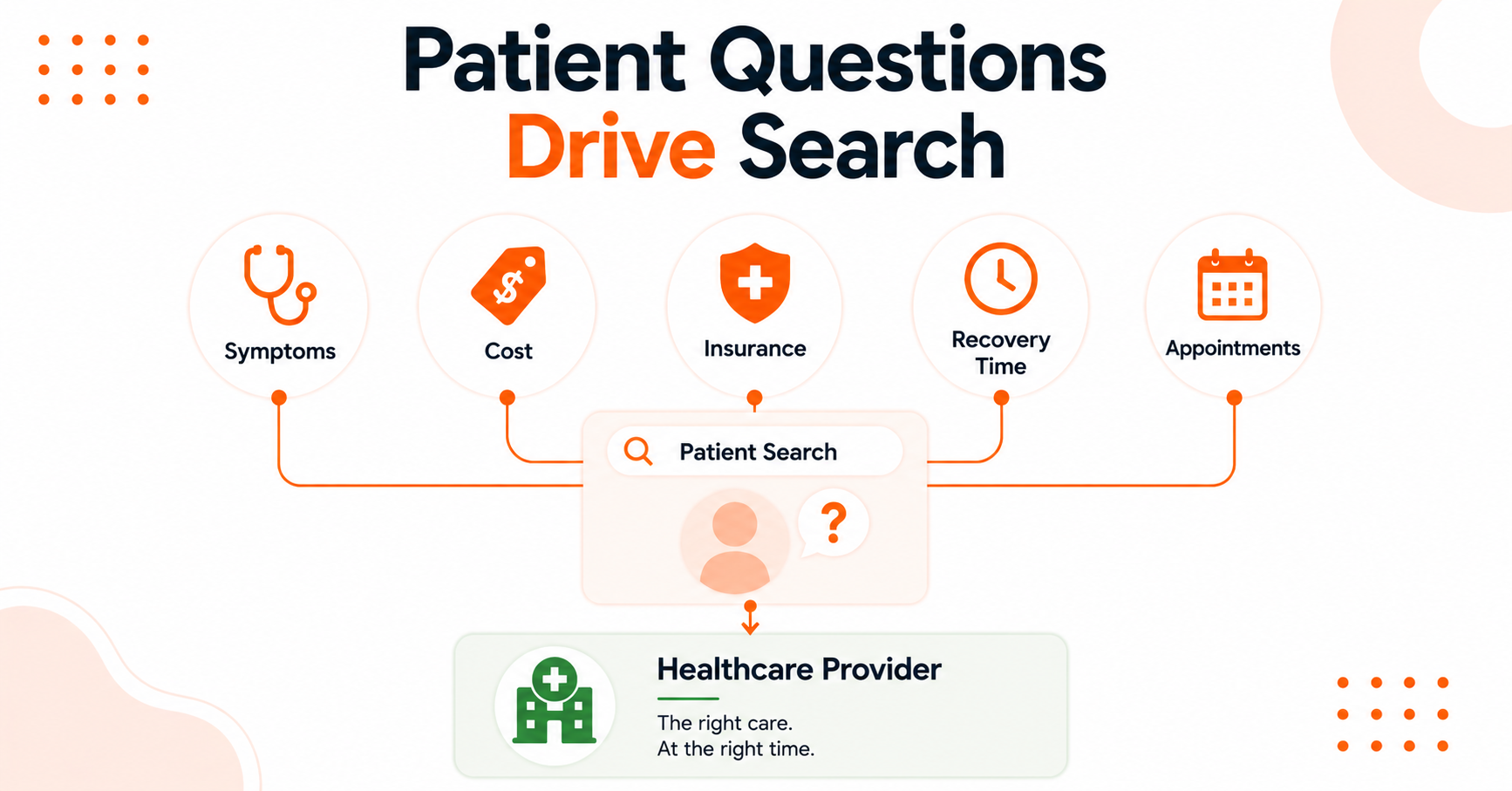
Build your pages around those specific moments. Service pages should match treatment intent, while location pages should match local intent.
Your FAQ pages should answer the exact questions your front desk hears every week. If patients consistently ask about insurance, recovery time, cost, side effects, or next available appointments, that content belongs on your site.
Ultimately, your content quality is determined by how accurately and concisely you answer patient questions.
Here is the part many teams miss: answer fast. Put the question in a heading and answer it within the first few lines.
Do not make people wade through a paragraph about your company mission before telling them what they came to learn. That structure also helps search engines and AI-driven systems pull clean, credible excerpts from your page.
Win Local Search Before You Chase Bigger Terms
For most healthcare brands, mastering local SEO is the most reliable way to drive qualified traffic.
Patients are rarely searching for healthcare services in the abstract. They are looking for a nearby provider that offers convenience, transparency, and an easy booking experience.
To capture that intent, prioritize:
- Google Business Profile optimization
- Local landing pages
- Review management
Start with the fundamentals of NAP consistency. Ensure your name, address, and phone number are identical across every directory, social platform, and directory listing you control.
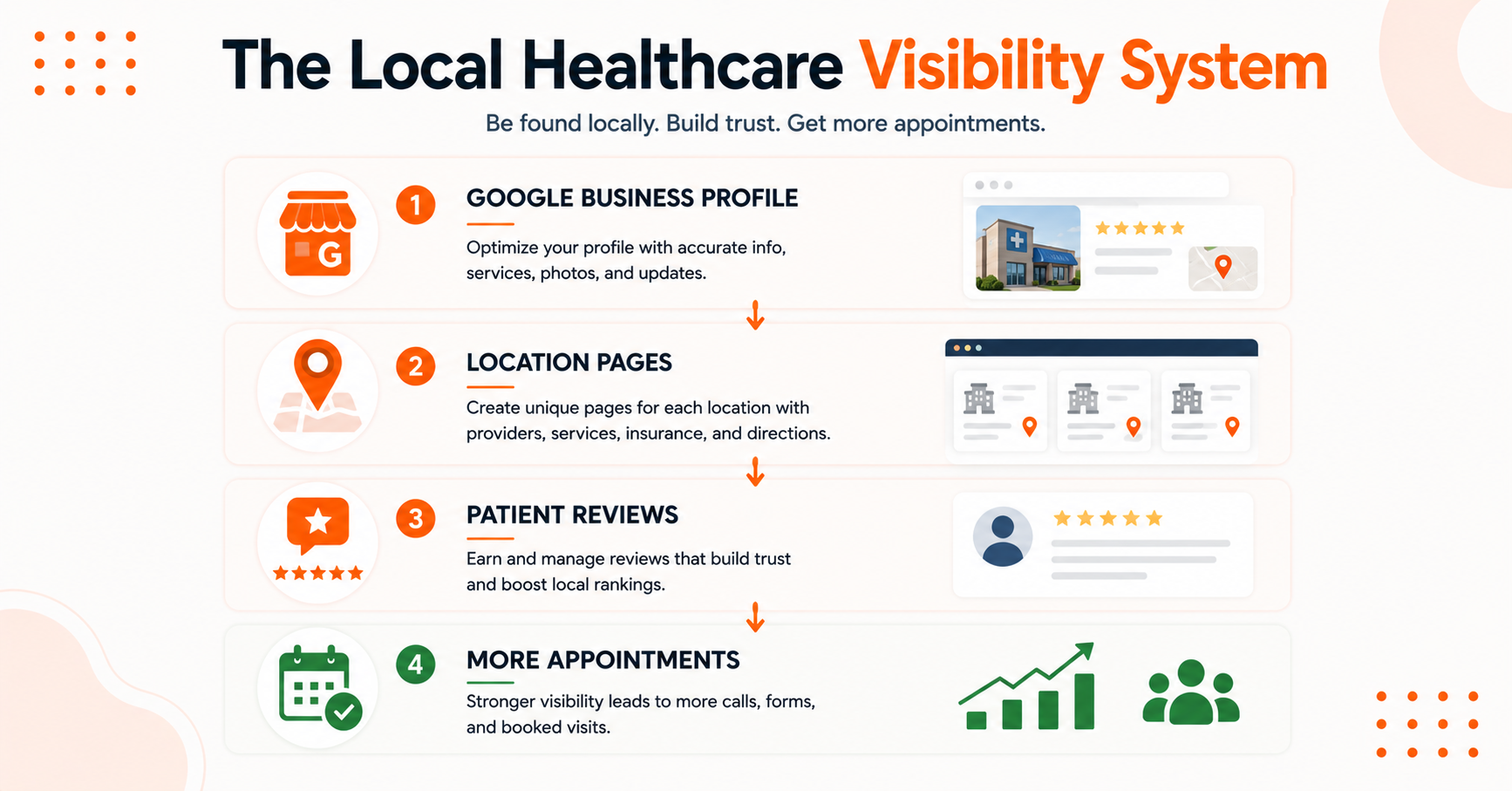
Beyond the basics, optimize provider pages for every location. Each office should have a unique page that includes:
- Provider details
- Service menus
- Accepted insurance plans
- High-quality photos
- Clear directions
When multiple offices are consolidated into one thin page, you fail to serve the specific needs of the local community. Focusing on unique location assets improves the user experience and makes it easier for patients to choose your practice.
Reviews are equally important for both search visibility and conversion rates. A steady stream of fresh reviews signals that your practice is active, trusted, and reliable.
When patients compare providers, they usually choose the one with recent, authentic feedback and a practice that responds like a human.
If you want a second opinion on where the market is heading, these healthcare SEO examples for 2026 align closely with what leading healthcare brands are already doing to dominate local markets.
Build Trust Into Every Page That Matters
Healthcare content falls into a high-trust category often classified by Google as YMYL (Your Money Your Life). Because of this, search engines evaluate your site through the lens of E-E-A-T (Experience, Expertise, Authoritativeness, and Trustworthiness).
Patients expect the same level of credibility. Thin pages, vague claims, and anonymous blog posts rarely perform well.
Your treatment pages, provider bios, condition guides, and FAQ content should demonstrate clear medical expertise. Include licensed reviewers when appropriate, provide verified author information, and keep medical content up to date.
Transparency also matters. Clear pricing information, office policies, and contact options help build trust with prospective patients.
Your website must perform well from a technical standpoint, too. Fast site speed and mobile optimization are no longer optional because they directly affect the user experience.
Effective healthcare SEO also includes:
- Schema markup
- Structured data for providers and locations
- Review schema
- FAQ schema where appropriate
These elements help search engines interpret your content more effectively. However, they will not compensate for weak content.
Securing backlinks from reputable healthcare organizations and medical journals can further strengthen domain authority. These signals help establish legitimacy and improve visibility in search results.
This overview of technical SEO best practices for 2026 provides a useful benchmark for building a strong foundation.
Finally, consider the modern search landscape. Patients no longer rely solely on traditional search results.
AI overviews and answer boxes often influence decisions before a website visit ever occurs. To stay visible, create content that is easy to scan, easy to quote, and inherently trustworthy.
Prioritize depth over volume. One well-structured page is far more valuable for SEO performance than several thin pages covering the same topic.
Track Leads, Not Vanity Metrics
Rankings feel good. Booked appointments are better.
The strongest healthcare SEO programs measure outcomes such as:
- Phone calls
- Form submissions
- Appointment requests
- Direction clicks
- Branded search growth
Google Search Console and GA4 can reveal the path, but your CRM or scheduling data should close the loop.
As you track these conversions, ensure your analytics setup maintains strict HIPAA compliance, whether you are managing data for a large health system or a private practice. If a page brings traffic but fails to generate patient action, it needs work.
Content refreshes matter as well. Provider rosters change, office hours shift, insurance plans are updated, and medical guidance evolves quickly.
When a page starts earning a strong organic search ranking, protect it. Prioritize content quality by updating information, strengthening internal links, and building supporting content around the topic.
That is how organic traffic compounds over time, following the same principle behind building compounding organic traffic.
FAQs About Healthcare SEO Strategy
Below are additional questions you might ask.
How Long Does Healthcare SEO Take to Work?
Some healthcare SEO improvements can produce results within weeks, especially Google Business Profile updates, review generation, and location page enhancements. Larger gains typically take three to six months and continue building as your authority, relevance, and content depth grow.
Maintaining high content quality is essential for turning those gains into sustainable long-term organic traffic.
What Matters Most for Multi-Location Healthcare Brands?
Each location needs its own strong page, accurate local listings, fresh reviews, and clear provider information. Shared boilerplate content across every office typically weakens visibility rather than improving it.
Search engines prefer unique content that directly addresses the needs of the local community.
Does AI Search Matter for Patient Acquisition?
Yes, AI search matters for patient acquisition because AI overviews influence trust earlier in the patient journey. Even when they do not generate an immediate click, they help shape patient decisions during the research phase.
If your pages answer questions clearly and demonstrate strong expertise, they are more likely to appear in these important early decision-making moments.
e strong, well-structured page is significantly more effective for your SEO performance than five thin pages that cover the same ground.
Turn More Healthcare Searches Into Patient Appointments
Generating more patient leads does not happen by publishing random content and hoping that Google figures it out. Real growth comes from a disciplined medical SEO approach focused on earning patient trust through high-quality answers to specific health concerns.
When you combine that credibility with a clear path to action, your website becomes a reliable resource for your community. That is the true objective of a strong healthcare SEO strategy: to be the clearest answer in the right place at the right time.
If you want help identifying where patient demand is leaking and uncovering opportunities to attract more qualified patient inquiries, Book a call and get a second opinion on your healthcare SEO strategy.


