

Managing a catalog for large ecommerce sites can quickly turn into an SEO nightmare. It is not because your products lack quality, but because your filters can multiply URLs like rabbits, creating endless variations that confuse search bots.
That is the core problem with faceted navigation SEO. While filters are essential for a smooth user experience, search engines do not enjoy crawling endless URL combinations.
Your goal is to balance these technical constraints with the needs of your shoppers, ensuring you maintain crawl efficiency and indexation health without negatively impacting your revenue.
Key Takeaways
- While faceted navigation is essential for a positive user experience, it can flood your site with thin content, duplicate, or near-duplicate URLs.
- Not every filter page should be indexable. The smart move is to keep pages with real search demand and suppress the rest.
- Crawl control and index control are different jobs. You usually need both.
- Canonical tags help, but they do not fix everything if search bots can still crawl endless filter combinations.
- Strategic internal linking should strengthen a small set of high-value filtered pages, not spray authority across thousands of low-value URLs.
- The goal is simple: protect crawl budget, consolidate authority, and grow organic revenue, not page count.
The win is not "let Google crawl every filter." The win is "let Google find the few filter pages that can actually rank and sell."
Why Faceted Navigation Breaks on Large Catalogs
Faceted navigation lets shoppers narrow a category by brand, size, color, price, material, rating, stock status, and various other filtering options. Useful? Absolutely. Harmless for SEO? Not even close.
Here is where things go sideways. Each filter adds another branch of URLs. Then another. Then combinations of combinations.
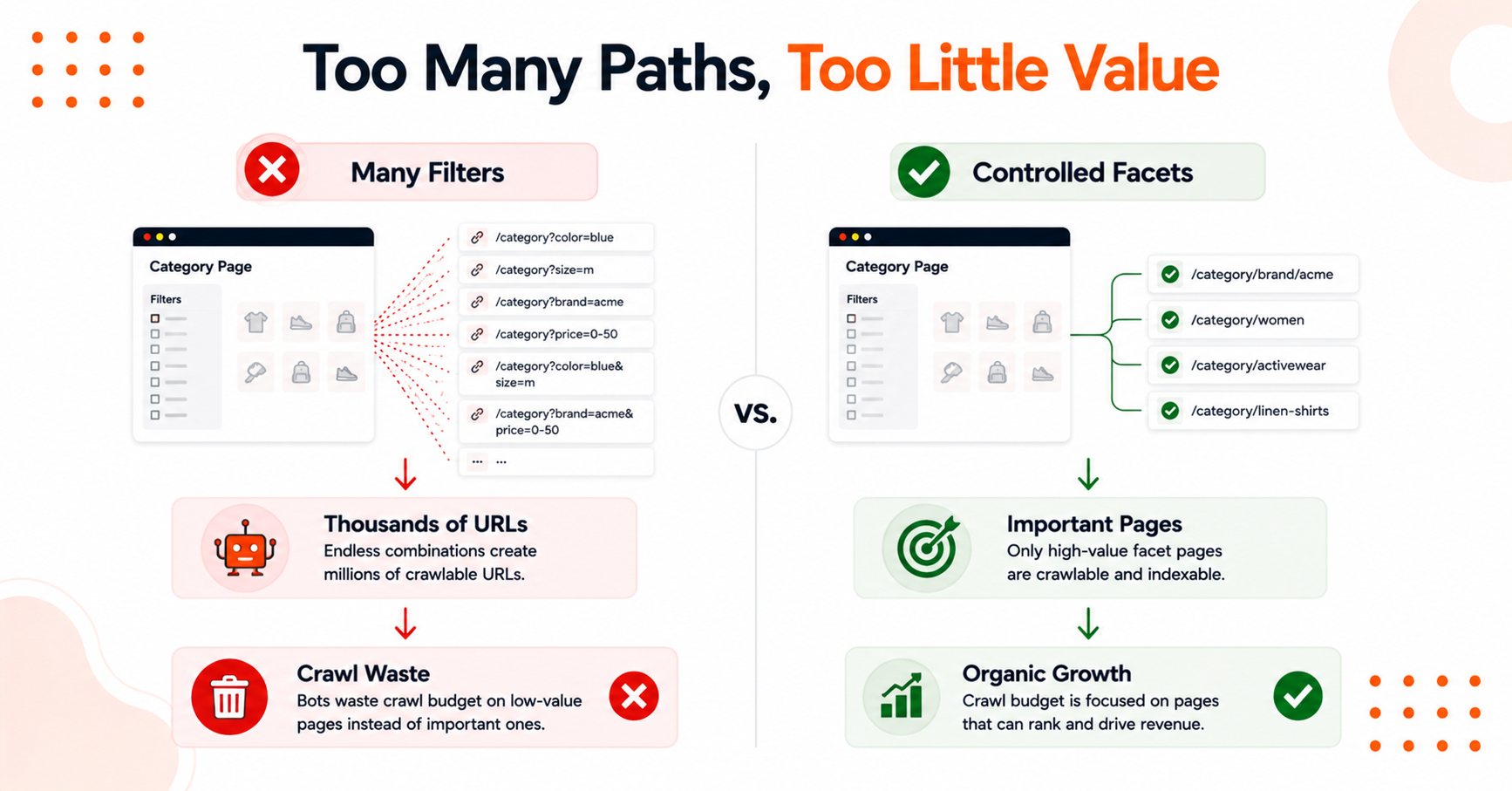
A category with ten filter types can quietly turn into thousands, sometimes millions, of crawlable states generated by unique URL parameters.
Think of it like a warehouse with every side door left open. Search engine crawlers do not know which doors matter most. They keep wandering into storage closets while your best category pages wait at the front.
That creates four common problems:
- Crawl wasteBots spend your limited crawl budget on junk URLs instead of your core categories and products.
- Index bloatToo many weak pages get indexed, which makes the whole site look less focused.
- Diluted authorityInternal links and external link signals get split across multiple versions of the same basic page.
- Thin differentiationIf a filter combination results in duplicate content, where "blue, size 9, under $100" looks almost the same as "blue, size 9, under $120," those URLs do not deserve separate lives in search.
This is not a fringe issue. It is one of the most common technical SEO problems on large ecommerce sites.
The good news is that the fix is usually not to remove filters. The fix is control.
Choose Indexable Facets With Real Demand
The biggest mistake is treating every filter state like a landing page. Most are not. Some are gold, but most are noise.
A good rule is to split facet pages into three buckets:
- Keep indexable pages that match real search behavior and help people buy.
- Keep crawlable but non-indexed pages that help users but do not deserve rankings.
- Stop creating crawlable URLs for low-value combinations in the first place.
That sounds simple because it is simple. The hard part is discipline.
Before you open any filter to indexing, ask three questions:
- Does this combination have real search demand?
- Is the page meaningfully different from the parent category?
- Can it convert if it ranks?
If the answer is no, no, and maybe, that page should not be in the index.
This quick reference usually holds up well:
Facet TypeUsually Indexable?WhyBrand + categoryOften yesStrong search demand and clear intentGender or audienceOften yesCreates distinct shopping pathsMaterial or styleSometimesWorks when demand is provenPrice rangesRarelyUsually too thin and too volatileSort orderNoNo search valueIn-stock onlyNoTemporary state, weak as a landing pageMulti-filter combinationsRarelyEasy to duplicate, hard to justify
The takeaway is not to index more pages; it is to index better pages. By focusing on specific long-tail keywords that align with genuine user queries, you can turn your filter system into a powerful discovery tool.
In practice, many high-performing stores use faceted search to create stable SEO landing pages for a small set of valuable combinations instead of opening the whole filter universe.
When you align your indexable pages with verified search demand, you gain cleaner URLs, stronger copy, tighter internal links, and a better shot at non-branded revenue.
This is long-game work, and that is the point. Every stronger collection page builds more authority, more trust, and more margin on future traffic.
Use Crawl and Index Controls Together
Now let's get practical. Good faceted navigation SEO depends on two separate controls: crawl control and index control. People blur those together all the time, but they shouldn't.
- Index control is about what can appear in search.
- Crawl control is about what bots spend time visiting.
A canonical tag helps with consolidation, but it is not a force field. If Google can still crawl a million low-value filter URLs, you still have a crawl problem. You just have a canonical tag sitting on top of it.
A noindex tag can keep pages out of search results, but it does not always stop crawling either. That matters on huge inventories where bot time is finite.
So what usually works?
- Use a canonical tag for close variants when you want signals consolidated to a stronger version.
- Use a noindex tag for pages that help users but should stay out of the index.
- Limit internal links to junk filter states.
- For truly low-value refinements, do not generate unique crawlable URLs at all if you can avoid it.
Instead, consider using AJAX navigation or other client side JavaScript solutions to ensure these states remain non-crawlable.
Be careful with robots.txt. Blocking faceted URLs in robots.txt can reduce crawling, but it also prevents bots from seeing on-page directives like canonical tags or noindex tags.
That is why blanket robots.txt disallow rules often create as many problems as they solve.
A better setup often looks like this:
- High-value facet pages get stable, crawlable, indexable URLs.
- Mid-value states stay usable for shoppers but are not indexed.
- Low-value combinations stay client-side.
This is also where URL structure matters more than most teams think. Keep URL parameters consistent in their order. Avoid multiple URL versions for the same state.
Do not let sort, pagination, and filter values pile into endless duplicate patterns. Proper parameter handling is essential to avoid the bloated crawl paths that plague large sites. Ensure your URL parameters are managed logically to prevent the creation of infinite paths.
And no, schema markup will not rescue messy filter logic. Breadcrumb, product, and collection markup can help search engines understand page meaning, and that same structure can help answer engines interpret the site more cleanly, but weak URL governance is still weak URL governance.
Strengthen Internal Linking and Watch Revenue
Once the right pages are chosen, support them like you mean it.
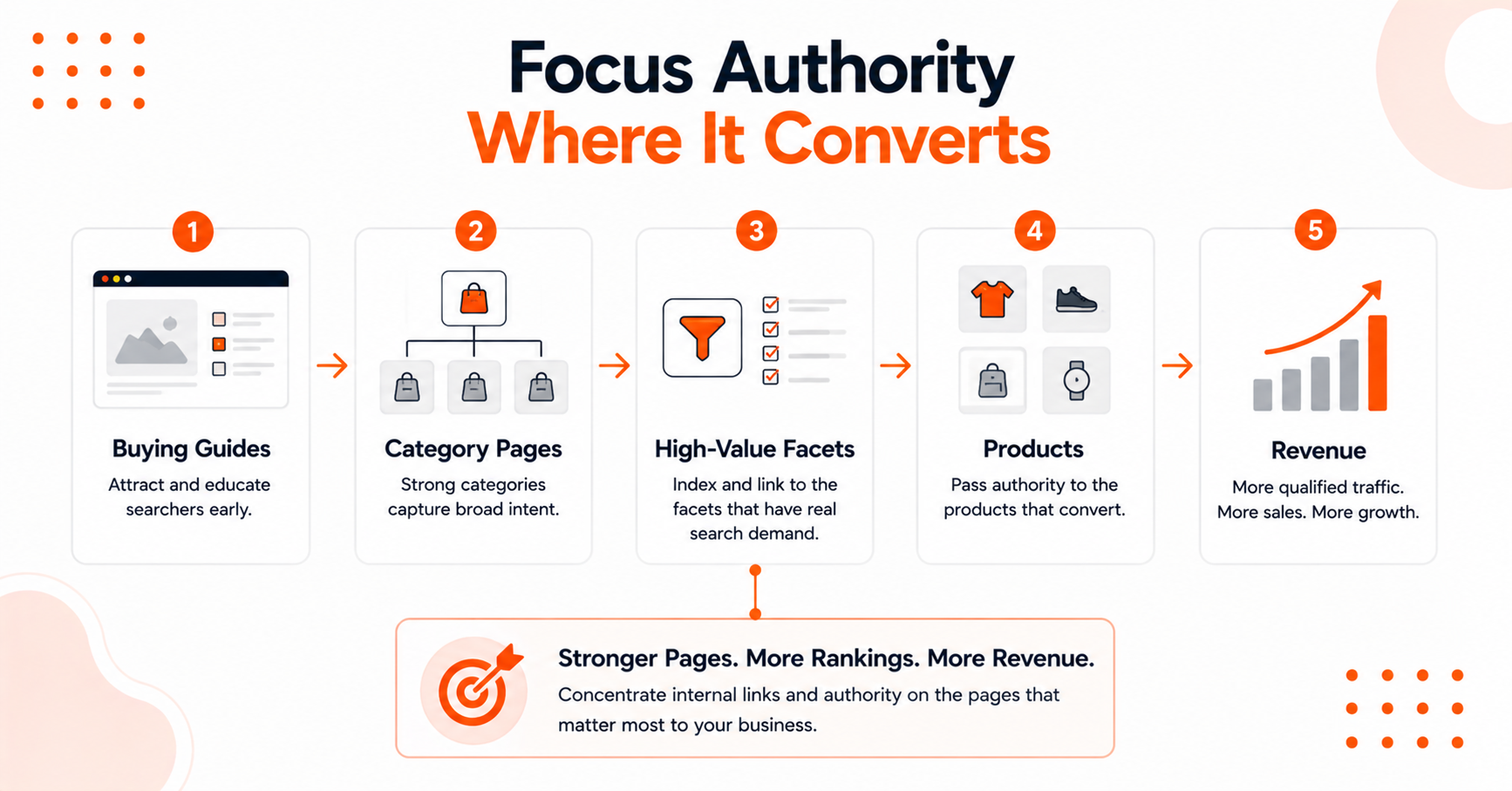
That means linking intentionally to the filtered pages that deserve to rank. Add internal links from:
- Category intros
- Buying guides
- Brand hubs
- Seasonal collections
- Related navigation paths
Do not dump every filter combination into crawlable menus, footers, and faceted widgets sitewide. That is how your link equity gets sprayed everywhere and concentrated nowhere.
The strongest faceted pages often behave more like curated category pages than raw filter results. They need clean titles, useful copy, smart product mixes, and enough context to help both users and search engines understand why the page exists.
Then measure what matters. Rankings are nice, but orders are better.
Perform a regular site audit to keep tabs on your progress. Watch indexed page counts, server logs, and Google Search Console performance.
Check which filtered pages earn non-brand impressions, which ones convert, and which ones soak up crawl without producing traffic.
If a page is stuck near page two, stronger copy, a tighter product mix, or a better FAQ section can move it.
For another outside perspective, Search Engine Journal's guide to faceted navigation is worth reviewing against your current setup.
FAQs About Faceted Navigation SEO
Below are related questions you might ask for.
Should Every Filter URL Canonicalize to the Parent Category?
No. If a filtered page has real demand and a clear purpose, it may deserve its own indexable URL. Using a canonical tag to point everything to the parent category can throw away valuable ranking opportunities for long-tail search queries.
Is Noindex Enough for Low-Value Faceted Pages?
Usually not. Noindex handles indexation, but it does not prevent crawl waste. If search bots can still reach endless URL parameters, you may need to block specific paths in your robots.txt file or use other methods to stop generating crawlable links for those low-value states.
Which Facet Pages Are Usually Worth Indexing?
Pages tied to strong search intent, like brand plus category or category plus audience, are often the best candidates. Price filters, sort orders, and temporary stock states usually aren't worth indexing because they rarely provide unique value to a search user.
Can Filtered Pages Drive Organic Revenue?
Yes, when they are chosen carefully. A small set of well-built facet pages can capture high-intent searches and grow non-branded revenue while helping you avoid the common trap of duplicate content.
The key is to support these pages with proper structured data, which allows product markup to complement your filter strategy and helps search engines better understand the offerings on your site.
Need Help Building Content Around Real Search Demand?
Large inventories do not lose organic growth because they have too many products. They lose it when search bots get trapped in endless variations of the same page, creating duplicate content issues that dilute authority and waste crawl resources.
Effective faceted navigation SEO is about control. Keep the pages that match genuine search demand, suppress the ones that do not, and focus your authority on the filtered pages that can actually rank and drive revenue.
Refresh helps businesses build SEO strategies and content that support sustainable organic growth. If you need help improving your ecommerce site's visibility and performance, schedule a call now!


