
Launching in a new country via cross-border DTC strategies can feel like opening a second storefront in the dark. You know demand exists, but if search engines, AI models, and your target customers cannot interpret your site architecture correctly, you remain invisible.
Successfully executing international SEO for DTC brands is not merely a translation project. It is a comprehensive market entry system. When direct-to-consumer businesses prioritize the right structure, language, and regional buying experience, they create a foundation for sustainable organic traffic growth that compounds long after the initial launch.
Key Takeaways
- Prioritize markets that already demonstrate organic demand rather than those that simply sound promising during planning meetings.
- Choose a site structure you can maintain for the long term, as the foundation of your technical SEO is what ensures long-term scalability and AI readiness.
- Move beyond basic translation to implement full content localization, ensuring that currency, shipping logistics, payment methods, and trust signals are tailored to the local audience.
- Utilize hreflang tags, clean site architecture, and structured data so search engines and AI tools can accurately match the correct page to the right market.
- Measure your success by analyzing country-level traffic, conversion rates, and revenue, rather than relying solely on aggregate global sessions.
Choose the Right Markets First
Many brands choose their next move based on geography, but a smarter approach relies on market prioritization driven by data.
Before you invest, check your Google Search Console to see where you are already receiving organic traffic, repeat customers, branded searches, or shipping demand. If countries like Canada, the UK, or Germany already appear in your analytics, they represent a much safer foundation for expansion than attempting to plant flags in random territories simultaneously.

Keep your first phase tight. One to three markets is usually the sweet spot for a successful launch because it gives you enough focus to learn what works, resolve technical issues, and avoid building five half-finished country experiences.
This strategic approach also fundamentally changes your keyword research. Do not simply port your U.S. keyword list into another language and call it a day.
Search behavior shifts by country, even when the population speaks the same language. A phrase that converts in the U.S. may sound awkward or have low intent in Australia or the UK.
Instead of relying on generic short-tail keywords, dig deeper to identify high-intent long-tail keywords specific to the nuances of each new region. By tailoring your content to these local search habits, you can establish a foundation for sustainable, predictable organic traffic growth.
A useful outside reference for this process is this global SEO priority guide.
Pick a Site Structure You Can Live With
Now for the part that often leads to expensive technical debt, your domain architecture.
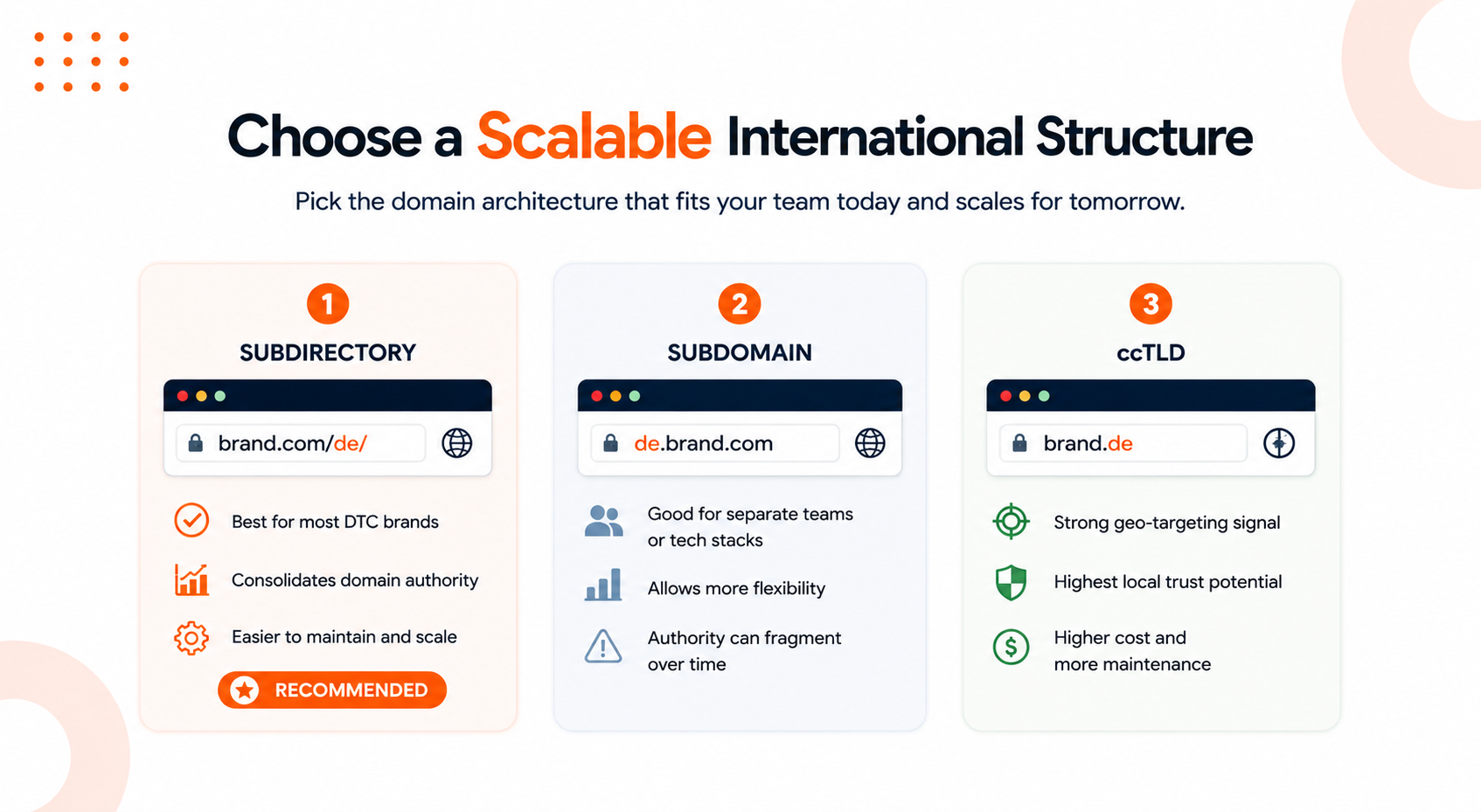
You generally have three choices when planning your site architecture: subdirectories, subdomains, or country-code top-level domains. There is no perfect solution, only the option your team can maintain effectively.
Here is a quick comparison:
StructureExampleBest ForWatch Out ForSubdirectorybrand.com/de/Most DTC brandsNeeds clean hreflang and localization rulesSubdomainde.brand.comSeparate teams or tech stacksAuthority can fragmentccTLDbrand.deStrong country targetingHigher cost and more maintenance
For most e-commerce SEO strategies, the subdirectory approach is the practical default. It is easier to maintain, simpler to scale, and keeps your domain authority consolidated. If you are using platforms like Shopify, Shopify Markets provides robust tools to manage these localized setups without needing a completely separate infrastructure.
Regardless of the structure you choose, implementing hreflang correctly is a critical component of technical SEO. This tag tells Google which language and regional page is intended for a specific user. Without it, you risk serving the wrong version of your site, splitting search signals, and creating duplicate content issues that could have been avoided.
If you want a second opinion on the basics, this international SEO overview for DTC brands covers the same core ingredients, including market-specific research, domain architecture, and localization.
For most e-commerce SEO strategies, the subdirectory approach is the practical default. It is easier to maintain, simpler to scale, and keeps your domain authority consolidated.
If you are using platforms like Shopify, Shopify Markets provides robust tools to manage these localized setups without needing a completely separate infrastructure.
Regardless of the structure you choose, implementing hreflang correctly is a critical component of technical SEO. This tag tells Google which language and regional page is intended for a specific user.
Without hreflang, you risk serving the wrong version of your site, splitting search signals, and creating duplicate content issues that could have been avoided.
If you want a second opinion on the basics, this international SEO overview for DTC brands covers the same core ingredients, including market-specific research, domain architecture, and localization.
Localize the Full Buying Journey, Not Just the Copy
This is where brands either win trust or burn it.
A translated product page is not a localized store. If prices stay in dollars, shipping windows stay vague, and checkout misses local payment methods, shoppers bounce fast.
If your new market page still feels like a U.S. store wearing a local language costume, it will not convert.
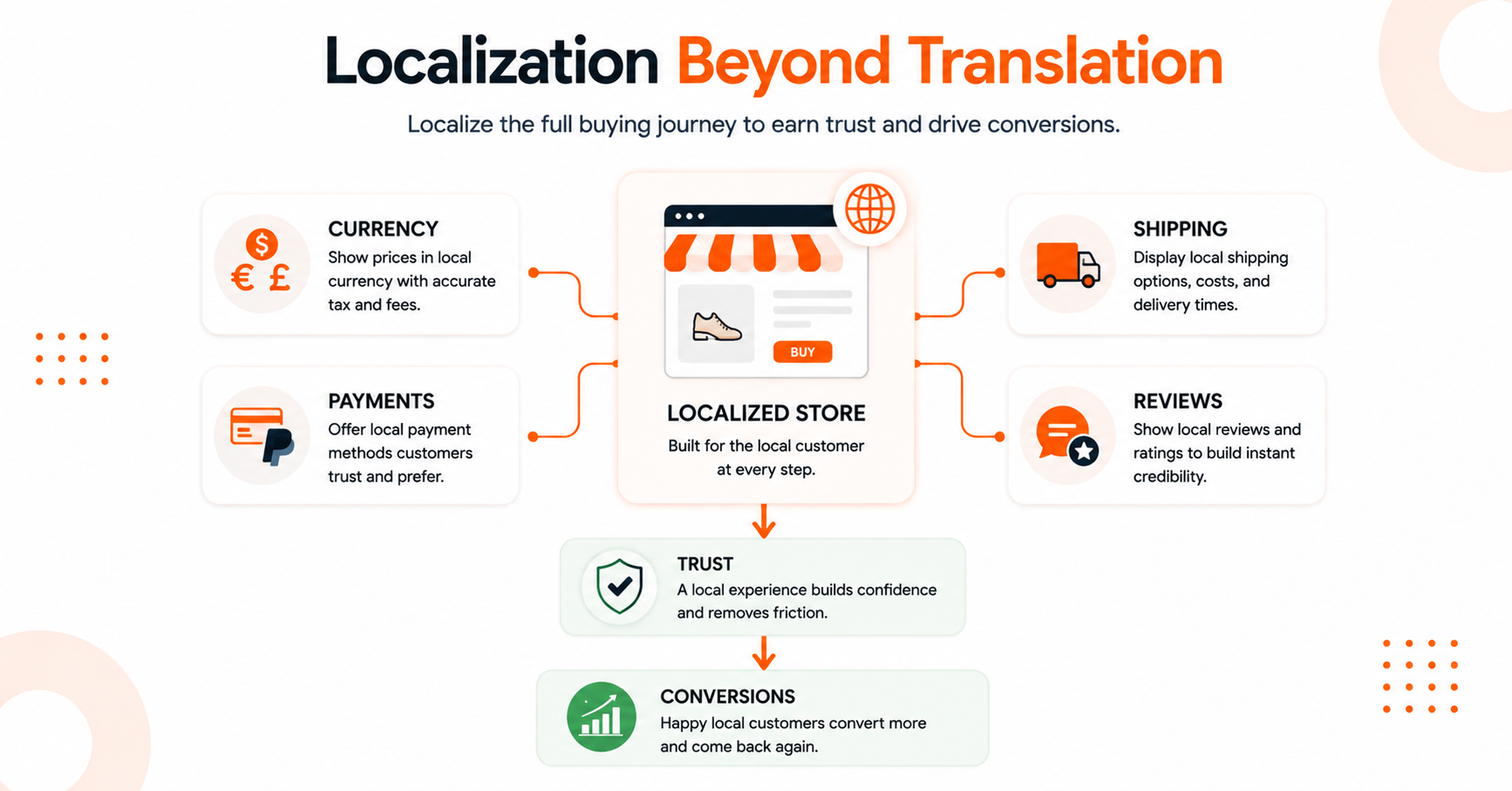
Effective content localization means matching exactly how your target audience shops. Product page optimization must go far beyond simple translation to include:
- Localized currency
- Tax calculations
- Metric measurements
- Local payment badges
- Region-specific shipping details
These trust signals are essential for long-term conversion rate optimization. The point is simple: search can bring the click, but the on-site experience has to close the gap.
Content needs the same treatment. Your category pages, product pages, FAQs, and support content should answer local questions in local language patterns.
This is equally important for traditional rankings and emerging search technologies. When it comes to AI engine locale targeting, tools like Google AI Overviews, ChatGPT, and Perplexity prioritize pages that are clear, structured, and easy to interpret.
If your localized page answers the question cleanly and in plain language, it has a much better shot at appearing in those answer layers.
For DTC brands, this means building more than standard product pages. Consider investing in:
- Buying guides
- Localized return policies
- Comparison content
By using proper structured data across these pages, you also increase your chances of appearing prominently on the search engine results page and capturing more qualified traffic in every market you enter.
Build Country-Level Authority and Track What Converts
Search engines evaluate more than just your website code. They analyze whether your brand has established genuine relevance within a specific country.
To achieve this, you must prioritize localized link building. Earn mentions, backlinks, and partnerships from sources native to your target market.
This includes:
- Securing placements in country-specific press
- Collaborating with local creators
- Partnering with regional distributors
- Working with review sites
Producing high-quality authority content that addresses local pain points is also essential for establishing your brand as a trusted resource. Furthermore, integrating user-generated content from local customers serves as powerful social proof that builds confidence with new audiences.
Generic link volume is not the goal. Earning local trust is.
Tracking your performance is equally critical. Global traffic metrics can often provide a false sense of success while local performance remains stagnant.
To drive sustainable organic traffic growth, monitor these key metrics:
- Organic traffic by market
- Conversion rate by market
- Revenue by market
- Top landing pages
- Branded search growth
You can track this performance effectively by segmenting your data within Google Search Console. Additionally, ensure you set up Google Merchant Center with localized product feeds to improve your visibility in regional shopping results.
Finally, do not ignore mobile performance. Since Google utilizes mobile-first indexing, your site must be optimized for the way local customers browse.
A large portion of DTC buying happens on smartphones, often on unstable connections. If your localized store is slow, cluttered, or confusing on a mobile device, even the strongest SEO strategy will struggle to convert that traffic into sales.
What Winning International SEO Looks Like
The best international SEO setup for a DTC brand is boring in the best way. The right markets are chosen early, the site structure is clean, and localized pages feel native to every visitor.
When search engines can easily understand your site and shoppers have a frictionless path to purchase, you create the foundation for a truly effective omnichannel retail strategy.
Successful international expansion is about more than just rankings. By providing a localized experience that resonates with local preferences, you build trust and significantly improve customer lifetime value over time.
Ultimately, this approach turns your global presence into a high-performing asset. A solid e-commerce SEO foundation is the key to sustainable organic traffic growth, allowing your brand to own its space in every market you enter.
FAQs About International SEO for DTC
Here are additional questions you might ask.
Should DTC Brands Use a ccTLD for Every Country?
No, DTC brands should not use a ccTLD for every country by default. While ccTLDs are a valid option, they often add unnecessary cost and complexity.
Most brands achieve better results using subdirectories with geo-specific modifiers in the URL structure. This approach streamlines your technical SEO efforts and simplifies management.
Unless you have large local teams, separate country operations, or a specific regulatory requirement to run each market independently, stick to a structure that allows you to manage hreflang tags more effectively across your site.
Is Translation Enough for International SEO?
No, translation is not enough for international SEO. Translation simply changes the words, but localization changes the entire user experience.
To succeed in e-commerce SEO, you must prioritize both. This involves product page optimization that respects local currency and sizing, as well as conversion rate optimization to ensure your checkout process feels native.
Ultimately, you need to establish local trust signals, such as regional payment methods and customer support, to turn visitors into buyers.
How Many Markets Should a Brand Enter at Once?
Usually, a brand should enter one to three markets at a time. Focusing on a small number of markets allows you to learn the nuances of each audience without spreading your team too thin.
Expansion becomes significantly easier once you have proven your model in these initial markets. By mastering the local landscape in a few regions first, you gain the operational experience necessary to scale your international efforts efficiently.
Does International SEO Help With AI Search Visibility Too?
Yes, international SEO helps improve AI search visibility. Clear page structure, localized FAQs, and strong entity signals are essential for visibility in both traditional search and AI-driven results.
The same content system that satisfies Google or Bing will also help you gain traction on regional search engines like Baidu or Naver. By providing direct, localized answers, you position your brand to appear in AI Overviews and answer engines, ensuring your products remain visible no matter how your customers choose to search.
Ready to Win on International SEO for Your DTC Brand?
International SEO success comes from making the right decisions early. When you prioritize the right markets, create localized experiences, and build a scalable technical foundation, you put your brand in a stronger position to grow across borders.
Refresh is a digital growth agency that helps brands improve their visibility through SEO, content strategy, and organic growth initiatives.
If you are preparing to enter new markets and want to build a stronger international SEO strategy, reach out to see how Refresh can help support your expansion goals.


