
When a content site has a strong editorial voice but still is not being found on Google, it is easy to assume the issue is technical SEO. Many teams respond by diving into audits and fixes. In our experience, the real issue is usually more foundational.
The site often lacks the content layer that connects its expertise to what people are actually searching for. Without that connection, even high quality content struggles to gain visibility.
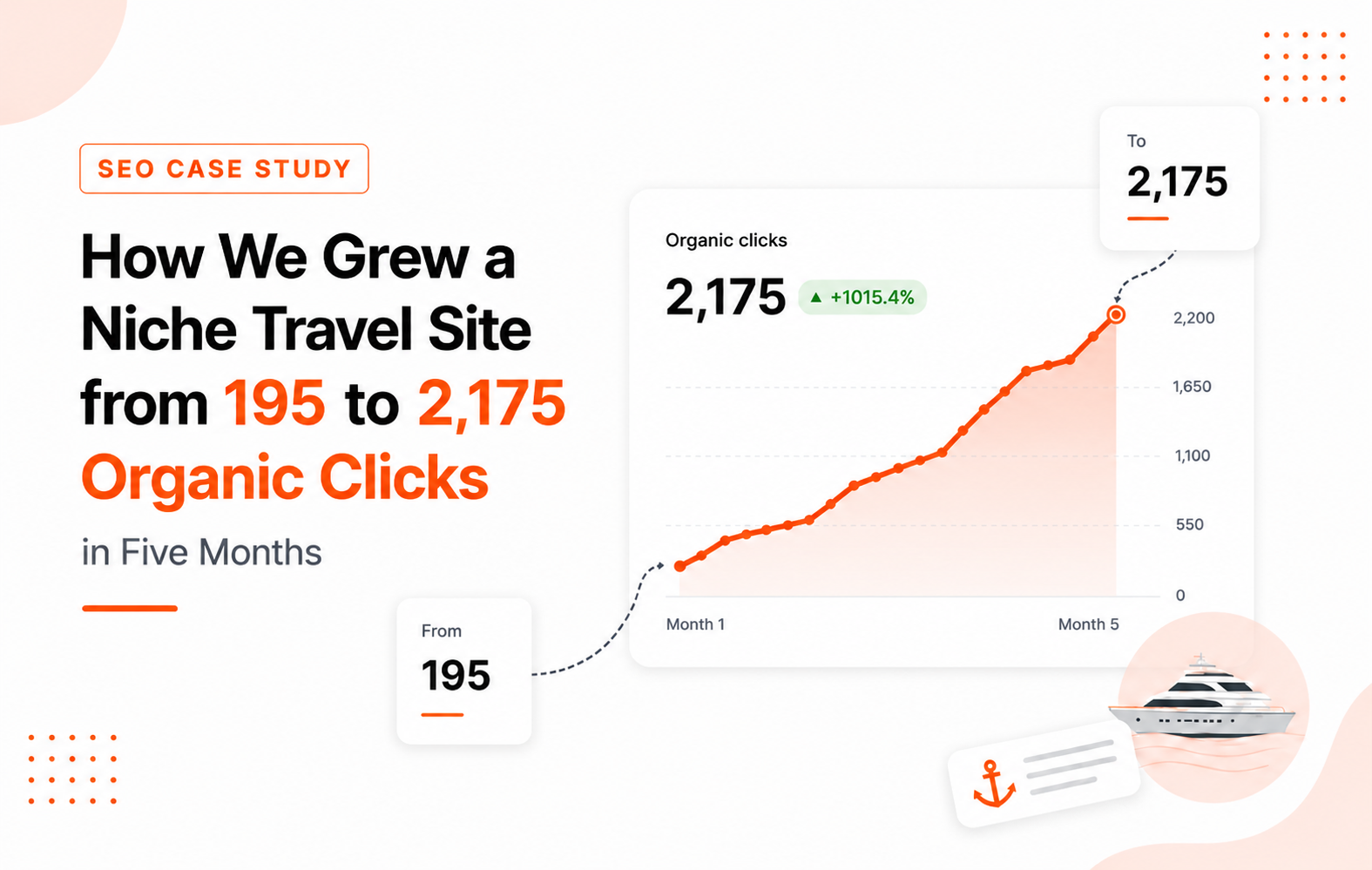
This is the story of how we built that layer for Port of Call Shopper, a niche cruise port shopping content site. Through five months of focused publishing and content expansion, the site grew from 195 organic clicks to 2,175 clicks between January and May 2026, while significantly improving visibility across a growing portfolio of destination-focused guides.
When Great Content Doesn't Rank, It's Rarely an SEO Problem
Port of Call Shopper is the work of Kathy Anderson, a retired travel and retail industry veteran. She turned decades of experience into a blog focused on authentic, handcrafted goods in ports and waterfront destinations around the world.
Kathy travels constantly through quarterly cruises, land trips, and extended time in the Pacific. Since 2020, she has also spent time living aboard a motor yacht in San Diego with her husband Scott and their dog Cooper, adding depth to her firsthand experience.
She meets artisans in their studios, visits independent galleries, and documents the craftsmanship that defines each place she visits. Her content is rooted in real conversations and on-the-ground discovery.
Her audience is just as specific as her niche. It includes affluent cruise travelers, residential ship residents, retirees who travel seasonally, and culturally minded shoppers looking for something authentic instead of mass produced souvenirs.
They are not looking for generic destination guides. They want insight from someone who has been there, met the artisan, and can guide them to the right neighborhood within a limited window of shore leave.
That audience exists, and Kathy’s content was already speaking to them. The problem was that almost none of them could find her through Google.
The Site That Had Everything Except Visibility
By every editorial measure, Port of Call Shopper was strong. Real expertise, real on-the-ground reporting, and a clear point of view that distinguished the work from the algorithmically-generated travel content that dominates the SERPs in this space.
By every search measure, the site was effectively invisible. From August through December 2025, the entire site generated:
- 195 organic clicks from Google — roughly 39 per month
- 17,700 impressions — meaning the site was being indexed, but rarely surfacing high enough to earn clicks
- An average position of 19.9 — the bottom of page two of search results
- A click-through rate of 1.1% — typical of pages that show up but don't rank competitively
Most of the existing content wasn't bad. It just wasn't structured around how people actually searched for cruise port shopping information. The site was answering questions no one was asking.
How We Built the Search Layer the Site Was Missing
Our diagnosis was clear: the site didn't need an SEO overhaul. It needed a focused publishing engine producing destination-specific content built around real, validated search intent.
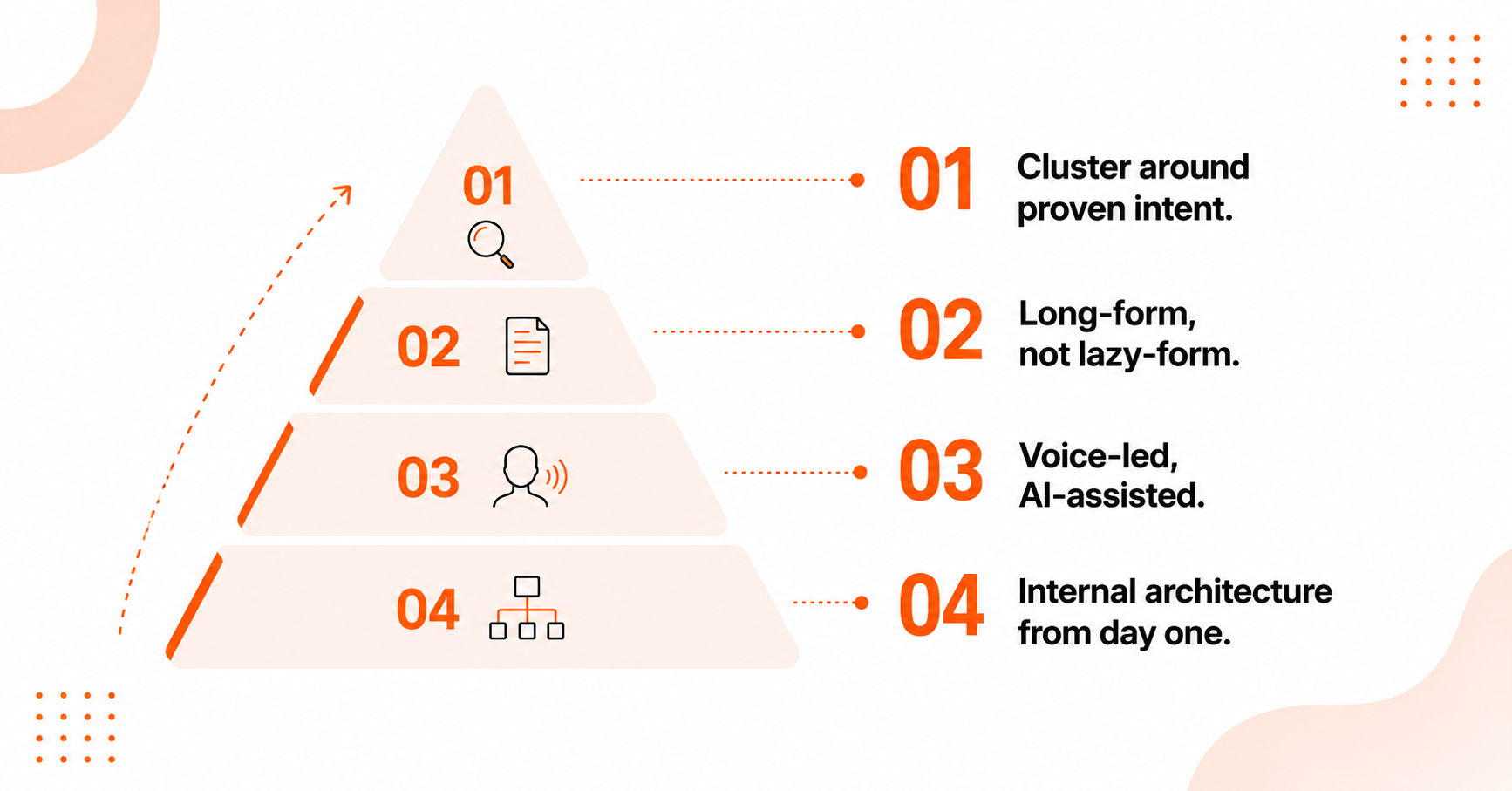
We mapped the strategy around four principles.
- Cluster around proven intent. Rather than guessing at topics, we used Google Search Console and keyword research to identify destinations with real search demand and weak existing competition. These were places where a high-quality long-form guide could plausibly rank in 60 to 90 days.
- Long-form, not lazy-form. Each new piece was a 1,800 to 2,500 word destination guide structured around the way readers actually search: where to shop, what to buy, insider tips, and practical logistics. Comprehensive enough to satisfy intent. Specific enough to outrank thin competitors.
- Voice-led, AI-assisted. We used AI tooling to scale production without sacrificing Kathy's editorial voice. Every piece reflected her first-person expertise, her relationships with local artisans, and the point of view that made the brand distinct. Generic AI content would have failed in this niche, and it should.
- Internal architecture from day one. Every new post linked to relevant siblings, building topical clusters that compounded ranking authority over time. We treated the publishing schedule as architectural, with each piece earning its place in a coherent library instead of simply adding to a feed.
What Five Months of Focused Publishing Actually Produced
Comparing the five months pre-engagement (August–December 2025) against the five months post-engagement (January–May 2026), every meaningful metric moved decisively:
The headline numbers are dramatic enough on their own. Clicks increased more than 11 times, impressions grew 6 times, and click-through rate nearly doubled. The metric we point strategists to first, however, is average position, which moved from 19.9 to 9.6.
That shift represents a move from the bottom of page two to page-one visibility. It is the point where a page transitions from being indexed but invisible to actually ranking. It also explains why click-through rate increased at the same time, since higher visibility naturally leads to more clicks per impression.
The Page That Outperformed the Entire Previous Site
Aggregate metrics are useful for headlines. They're not always useful for understanding what actually happened.
The clearer story emerges when you look at individual pages. Of the top eight pages driving traffic in the post-engagement period, every single one had zero clicks pre-engagement. Every one of them is content we built from scratch during the engagement.
How One Destination Guide Pulled 653 Clicks
The single best performing piece was a destination guide for San José del Cabo cruise port shopping. It went from 0 to 653 clicks and 0 to 16,030 impressions in five months. On its own, that one post outperformed the entire pre engagement site by more than three times.
The other top performers followed the same pattern. Caribbean handcrafted souvenir guides, Costa Rica cultural shopping content, and Mediterranean port pieces all started from zero and moved into ranking territory within weeks. This is the editorial flywheel working as intended.
A single well targeted piece built around real demand can outperform dozens of unfocused posts. When content is structured for both readers and search engines, results compound quickly.
Ranking Across a Wide Query Footprint
One question we always anticipate when results look this dramatic: did you just get lucky with one keyword?
No. The query data shows the opposite. Traffic is coming from a wide footprint of related searches, which is what real topical authority looks like.
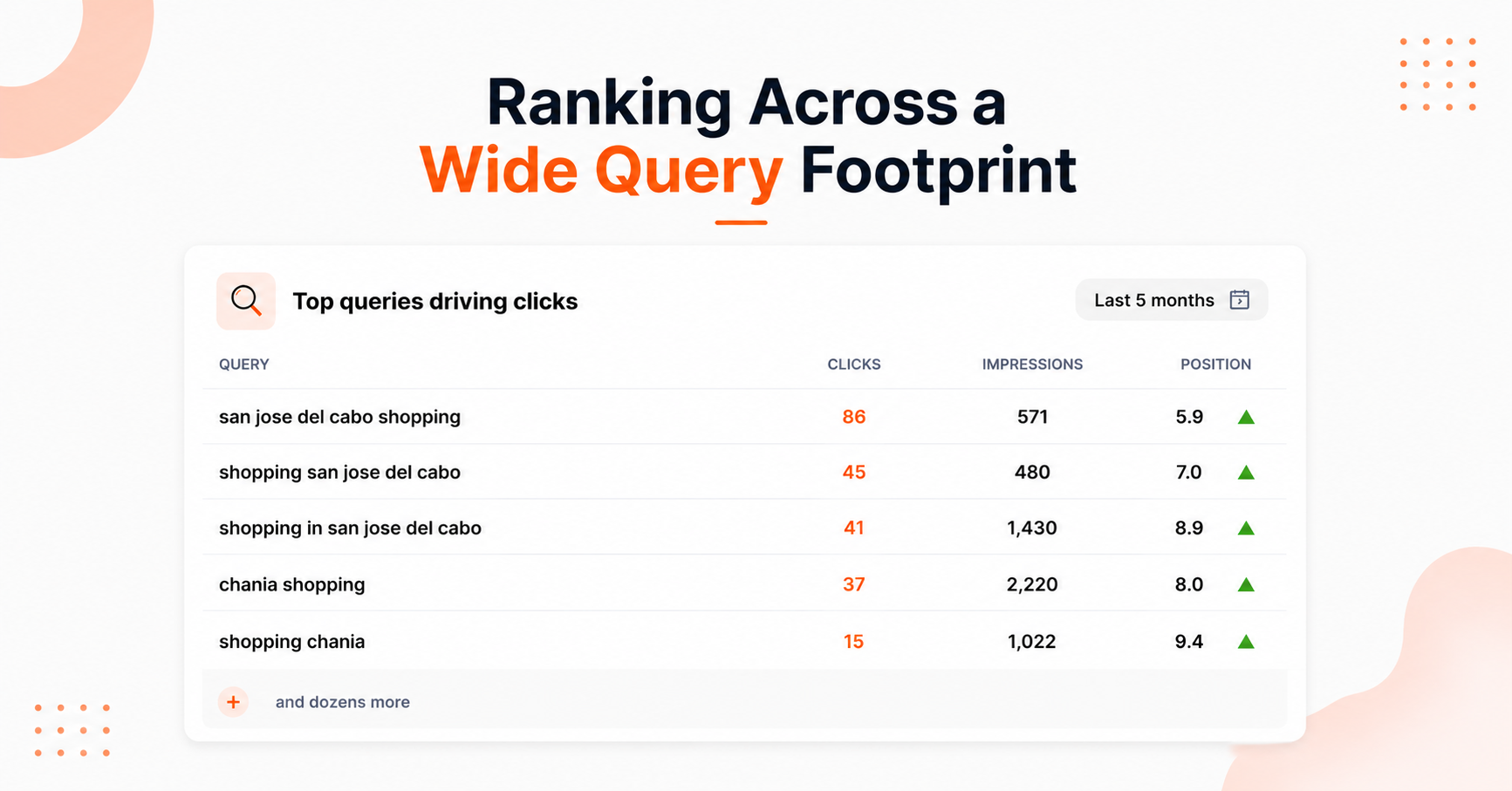
The site is now ranking and earning clicks across a tight cluster of cruise port shopping queries, including:
- san jose del cabo shopping
- shopping in san jose del cabo
- best shopping in san jose del cabo
- chania shopping
- shopping in chania crete
- and dozens more
Most of these queries had zero clicks before. Several had zero impressions.
That breadth is the point. A site that ranks for one query is exposed to risk. A site that ranks across dozens of related queries builds stability, authority, and real leverage.
This is the kind of footprint that destination management organizations, tourism boards, and travel partners look for when evaluating editorial partners. It opens the door to guest posts, backlinks, and long term collaborations.
The Mechanics That Actually Produced the Result
We are skeptical of case studies that imply a magic methodology. The mechanics here are not exotic. They are a small set of disciplines executed consistently.
- We started from real demand, not opinions. Every piece was built to target queries with verified search volume and reachable competition. We did not publish anything because it felt important. We published because the data showed it could rank.
- We respected the publisher’s voice. AI tooling allowed us to scale production. Kathy’s editorial voice, first person, experiential, and grounded in her relationships with local artisans and global craftspeople, kept the work from sounding generic.
- We built an architecture, not a feed. Each new post connected to others through deliberate internal linking. This strengthened topical authority and helped the site behave like a library instead of a blog roll.
- We let the data lead the cadence. Early posts revealed which clusters had the strongest demand. We doubled down on those instead of spreading the publishing schedule thin.
Why the Curve Is Still Climbing
Five months in, the trajectory is still accelerating. The post engagement curve has not plateaued. It continues to climb, which is what we expect from a content engine that is still building a compounding library.
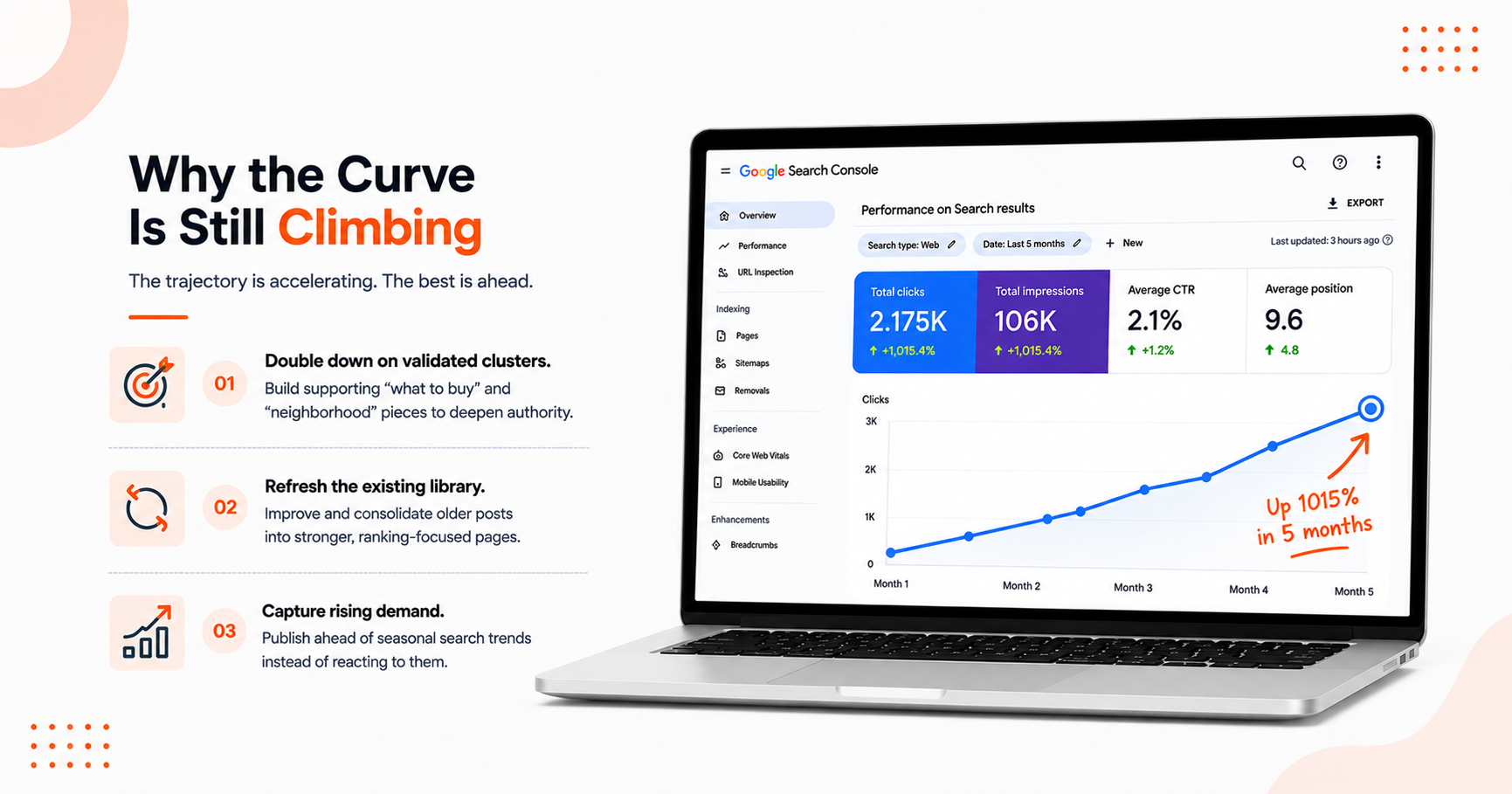
The next 90 days will focus on three priorities:
- Doubling down on validated clusters. Destinations where the first guide ranked well will get supporting “what to buy” and “neighborhood” pieces. This deepens topical authority and makes the site a more attractive editorial partner for DMOs and tourism boards.
- Refreshing the existing library. Older posts from before the engagement will be evaluated and improved. Some will be updated to current SEO standards, while others will be consolidated into stronger, ranking focused pages.
- Capturing rising demand. Several queries already show increasing search volume as cruise destinations enter peak booking season. We will publish ahead of those trends instead of reacting to them.
Organic search builds the audience, but the newsletter supports that growth over time. It gives readers a way to stay connected to new destination guides as the site continues to expand.
For readers who want to follow along more closely, the Port of Call Shopper Crew offers a simple way to stay in the loop between trips. It keeps the relationship active as new content is published and new destinations are added.
The goal of an organic content engine is compounding growth. Paid traffic stops the moment spending stops. Editorial assets like these continue working and earning long after they are published.
Want This Kind of Curve for Your Site?
If you are building a content brand and your rankings have not yet caught up to your editorial quality, it is usually not a content problem. It is a distribution and structure problem.
At Refresh, we help publishers and brands turn strong editorial work into organic growth. That includes SEO, answer engine optimization, and content systems built to scale what works.
Beyond blog content like Kathy’s, we also extend the strategy into video. This creates a second discovery layer where the same expertise can reach new audiences and reinforce existing rankings. Schedule a call now!


