
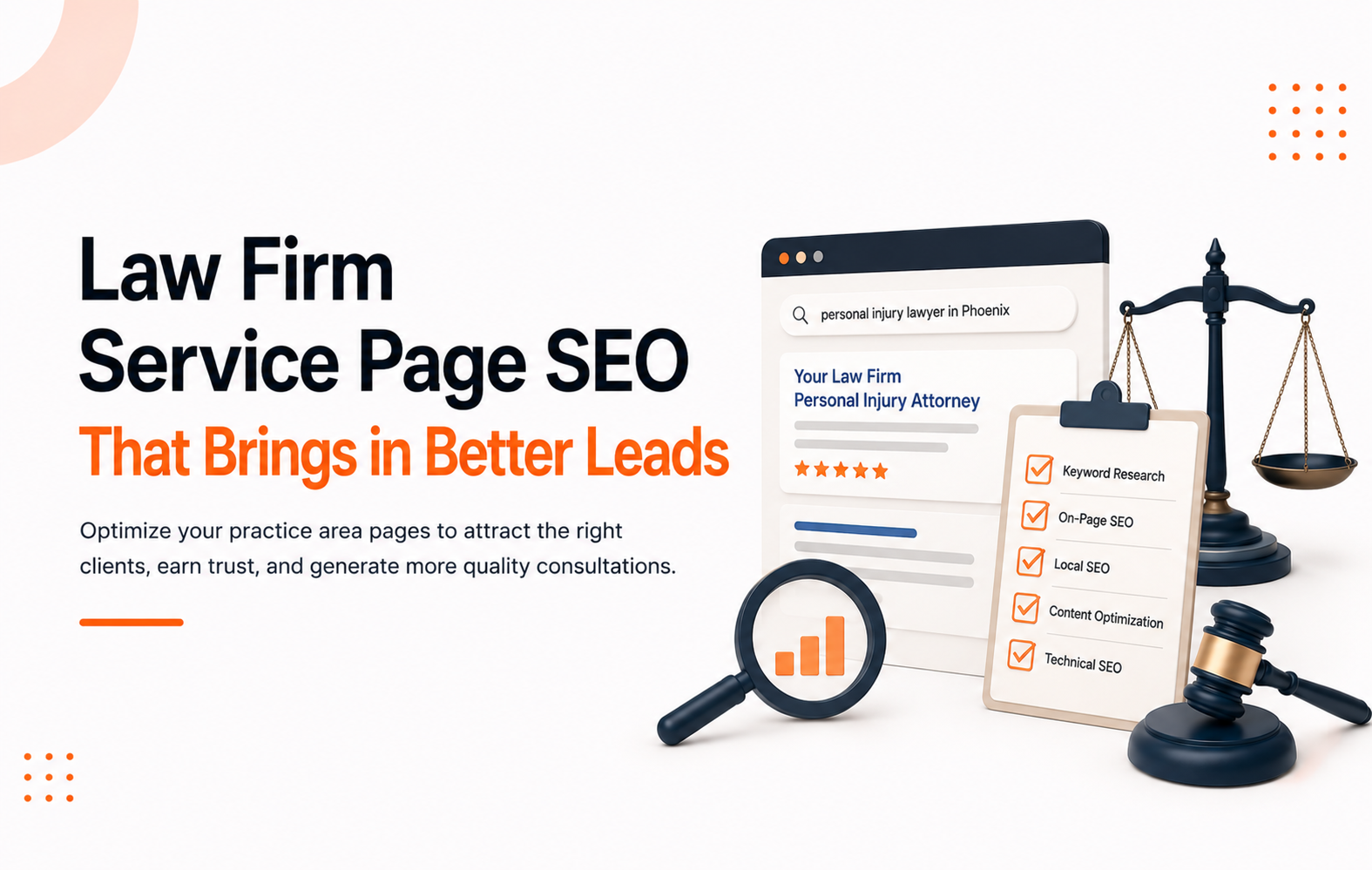
A law firm service page can rank well and still waste your intake team's time. Even if your site performs strongly in organic search results, you may still attract the wrong case types, the wrong locations, or people who were never going to hire counsel.
In those situations, traffic numbers look good, but revenue remains stagnant. That is the real challenge that law firm service page SEO is designed to solve.
The goal is not more clicks for the sake of it. It is about attracting better cases, generating more productive consultations, and filtering out junk leads before they reach your pipeline.
This guide explains how to build practice area pages that align with search intent, improve lead quality, and support long-term growth for your law firm.
Key Takeaways
- High-converting practice area pages focus on one clear intent rather than mixing multiple topics.
- The best pages answer the primary search intent quickly to satisfy users while establishing immediate trust.
- Integrating local SEO signals with attorney credibility helps your firm stay visible in both traditional search results and AI-driven discovery.
- Track qualified consultations and signed cases as your primary success metrics, rather than focusing on vanity metrics like rankings alone.
Why Most Law Firm Service Pages Miss the Mark
A lot of firms publish pages that read like brochures. They are polished enough, but completely forgettable because they focus on the firm's history, values, and broad capabilities before answering the one thing the searcher cares about: "Can you help with my exact legal problem, here, right now?"
That mismatch is expensive.
Someone searching for a truck accident lawyer in Phoenix does not want a vague personal injury page with six practice areas crammed into one template. Likewise, a parent looking for a child custody attorney should not have to dig through a generic family law overview.
Search intent is almost always narrower than most law firm sites admit. By failing to create specific practice area pages, firms often miss the opportunity to connect with clients at the exact moment of need.
Because legal content falls into the YMYL (Your Money or Your Life) category, search engines hold your site to a higher standard. You must demonstrate E-E-A-T (Experience, Expertise, Authoritativeness, and Trustworthiness) on every page.
Through thoughtful keyword research, you can identify the specific terms your clients are actually using. This helps you avoid the one-page-fits-all trap and ensures your content aligns with what searchers are looking for.
A service page should attract the right case and repel the wrong one.
That is why one-page-fits-all rarely works. Separate pages make sense whenever the case type, urgency, or location changes the searcher's question.
Examples include:
- Plaintiff law
- Defense law
- Family law
- Criminal law
- Estate law
- Business law
Each practice area has its own language, stakes, and conversion triggers.
There is a bigger shift happening as well. People still search Google, but they increasingly ask AI tools direct questions.
Clean structure, direct answers, and consistent facts help your firm appear in both places. These specific pages also create valuable opportunities for local SEO improvements, helping you capture relevant traffic within your geographic area.
If you want the bigger picture on how search supports attorney lead flow, you can use internal linking to direct readers to MyCase's guide to attorney lead generation as a useful reference point.
What High-Performing Law Firm Service Pages Include
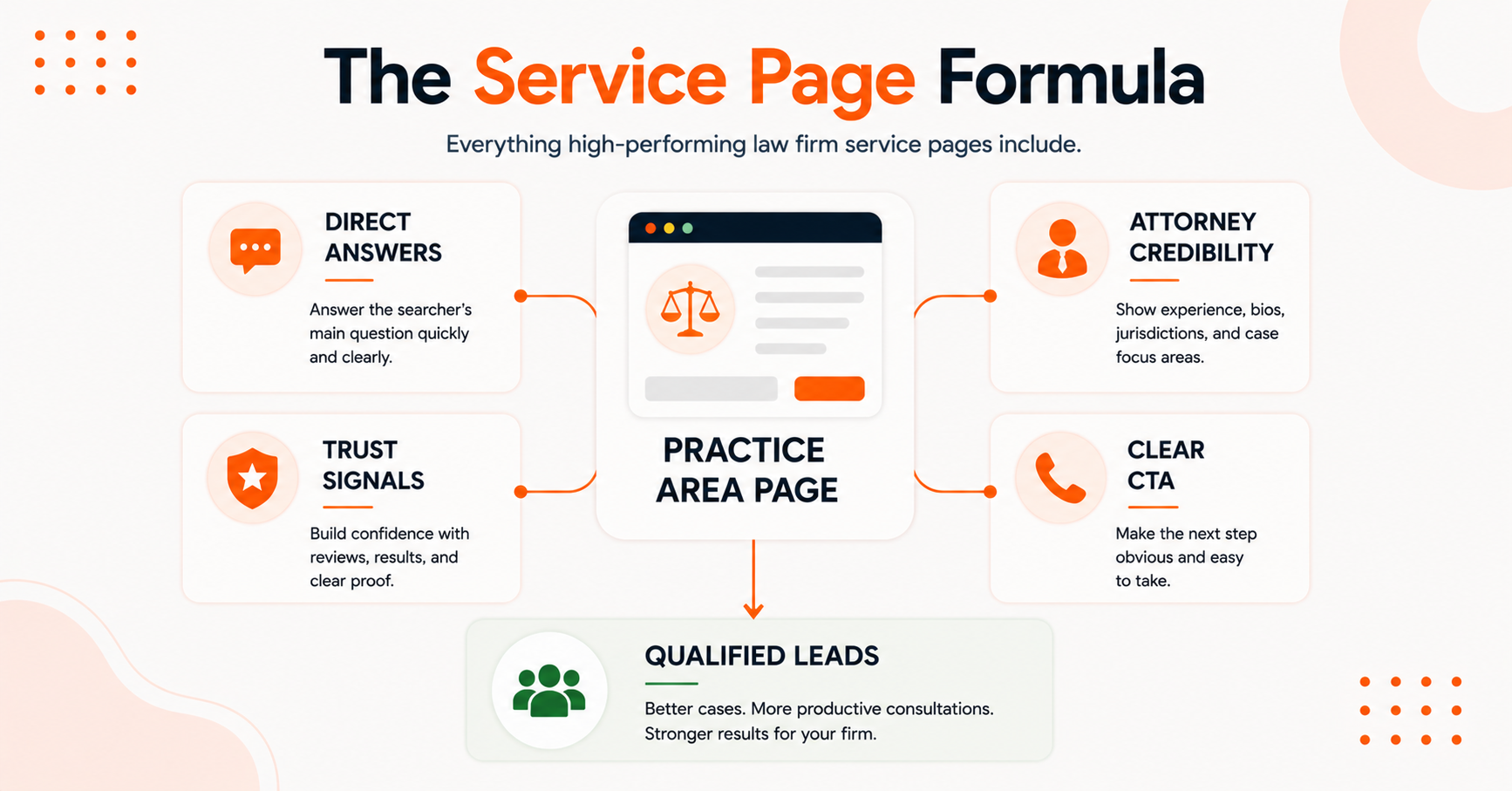
Start with the first screen of the page. It should immediately explain what you do, who you help, and where you help them.
If someone lands on your DUI page, they should know within seconds whether the page covers first-time offenses, felony charges, license issues, or all of the above.
Then get to the answer early. Not in paragraph seven. Right away.
A strong opening section often accomplishes three things in fewer than 100 words:
- Names the problem.
- Explains when legal help makes sense.
- Tells the reader what the next step looks like.
That structure helps people make decisions. It also helps search engines and AI systems lift a clean answer from the page.
After that, the page needs proof. Not fluff, proof.
Examples of strong trust signals include:
- Detailed attorney bios
- Years of experience
- Jurisdictions served
- Process details
- Case types handled
- Carefully presented reviews or results where ethics rules allow
These attorney bios are especially important because they show potential clients the human expertise behind the firm. If your state bar has strict advertising rules, make sure every claim complies with them.
A good service page also makes the next action obvious to support your conversion rate optimization strategy. Include a clear phone number, contact form, and office location.
Tell readers exactly what happens after they contact the firm. Removing uncertainty often improves conversions.
Finally, the technical side matters. Your pages need to load quickly and work flawlessly on mobile devices.
Effective on-page optimization requires:
- Managing Core Web Vitals
- Implementing schema markup
- Writing effective title tags
- Creating compelling meta descriptions
These elements help search engines interpret your content and improve visibility in search results. However, schema markup will not save weak writing. The page still has to answer first and prove second.
Write for Search Intent, Not for Your Org Chart
Many law firms build pages around internal organizational structures rather than the phrases real clients use. Your firm may think in departments, but prospective clients think in terms of specific legal problems.
To bridge that gap, prioritize search intent. Conduct thorough keyword research to identify the long-tail keywords that reflect how potential clients actually describe their situations.
Instead of abstract branding, target action-oriented queries such as:
- Probate lawyer near me
- How long do I have to file after a car accident?
- Child custody lawyer in Phoenix
- Business litigation attorney near me
Your service pages should mirror these questions and provide clear, direct answers in plain English.
Effective on-page optimization also requires headings that reflect user questions. Rather than cramming multiple legal issues onto one page, organize your practice area pages into logical topic clusters.
This improves user experience while helping you build topical authority in the eyes of search engines.
To strengthen those clusters, use strategic internal linking between service pages, attorney bios, and supporting blog content. This creates a cohesive content ecosystem that guides visitors toward the information they need.
Finally, incorporate visible FAQs into your page design. FAQs provide space to address common objections, timing concerns, and process questions without bloating the main copy.
Keep the questions authentic, provide concise answers, and maintain a clean structure to maximize visibility in answer-based search results.
Measure Lead Quality, Not Vanity Metrics
If the page is doing its job, rankings are only part of the story. The more important question is whether it attracts the kinds of matters you want more of.
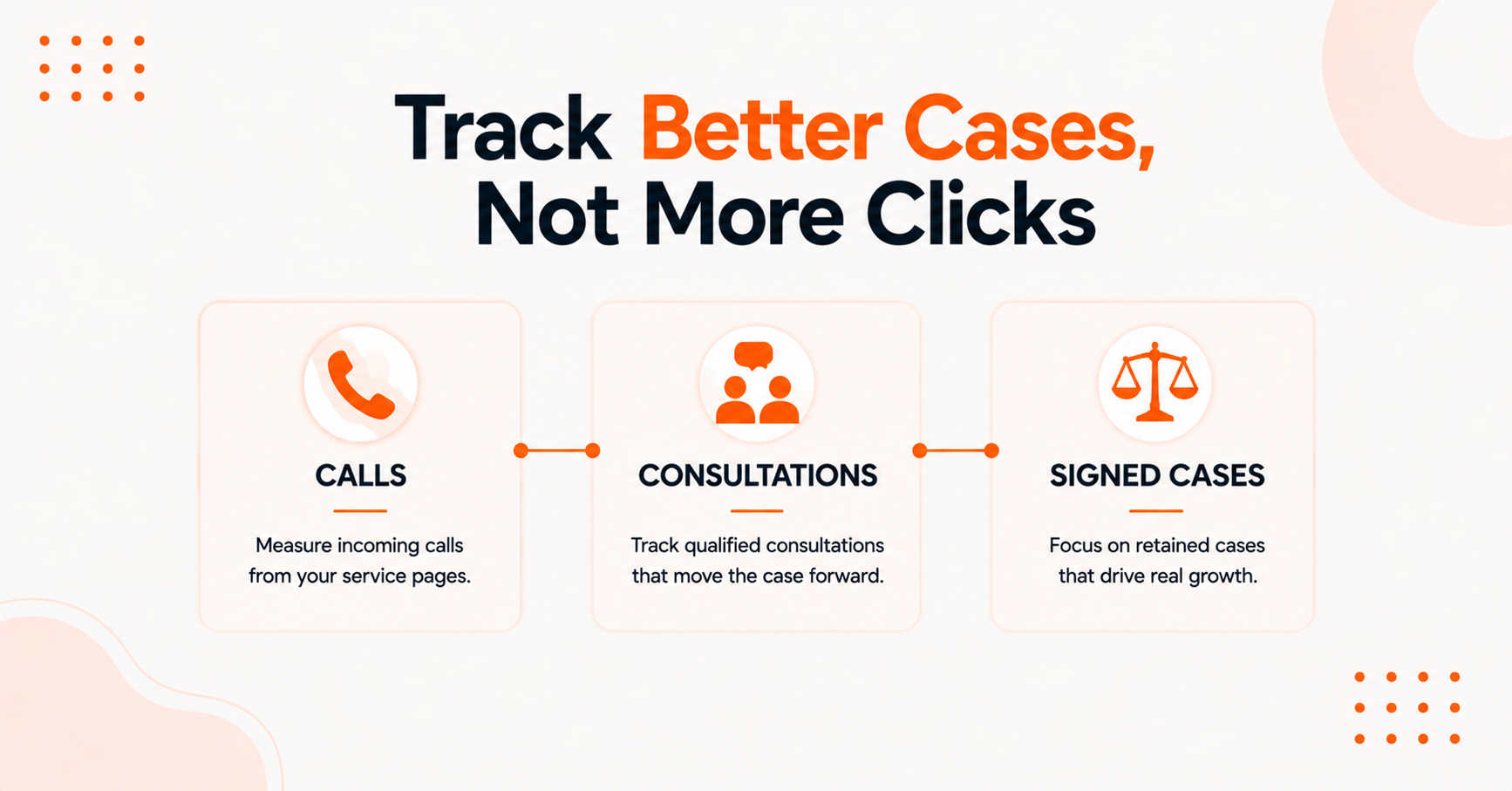
Track performance metrics such as:
- Page-level calls
- Form submissions
- Consultation rates
- Signed-case rates by practice area
Tie your SEO data directly to intake outcomes. If your business litigation page generates fewer leads than a general business law page but consistently attracts better matters, that is still a win.
This is also where patience matters. Service-page SEO is long-game work.
While on-page optimization is essential, sustainable organic search results often require consistent link building from reputable legal directories to earn high-quality backlinks. Combined with a strong site architecture, these efforts create a compound effect over time.
Unlike paid ads, which stop producing results when the budget ends, a well-optimized page can continue earning trust, traffic, and consultations month after month.
For a realistic view of timing and legal marketing expectations, this law firm SEO strategy guide provides a fair baseline.
When a page earns impressions but struggles to convert, do not scrap it immediately. Start by improving the user experience and auditing your technical SEO.
Focus on:
- Tightening the opening section
- Clarifying case fit
- Strengthening the call to action
- Adding stronger trust signals
- Refreshing FAQs
Small, iterative improvements can quickly change the quality of leads and help the page perform better over the long term.
FAQs About Law Firm Service Page SEO
Here are a few more questions that may help you.
Should Each Practice Area Have Its Own Page?
Usually, yes. If the search intent is different, the page should be different too.
Divorce, child custody, DUI defense, probate, and breach of contract are not the same search. By conducting thorough keyword research, you can determine whether the search volume justifies separate pages or if broader terms can be grouped.
Distinct pages allow for better targeting and demonstrate deeper expertise in specific legal areas.
Can One Service Page Target Multiple Cities?
Yes, but only to a point. If each city has meaningful search demand, separate pages are often the better option.
When targeting specific areas, ensure your Google Business Profile is optimized for each location. Maintaining strict NAP consistency (Name, Address, Phone) across your website and legal directories is essential for local SEO.
These signals are critical for earning a spot in the local map pack, which is often the most valuable real estate for capturing local leads.
Do FAQs Still Help Law Firm Service Pages?
Yes, FAQs still help law firm service pages by providing fast answers and creating clearer structure for search systems. The questions should be visible on the page and written for real clients rather than bots.
Using keyword research to identify common client pain points helps ensure your FAQs directly address what potential leads are searching for online.
How Long Does Service Page SEO Take for a Law Firm?
Some service page SEO improvements can produce results within weeks, especially on pages that already have impressions. Simple updates, such as improving title tags and meta descriptions, can provide an immediate boost in click-through rates.
However, broader success with local SEO typically takes months because building authority, relevance, and trust is a cumulative process that develops over time.
Turn More Service Page Traffic Into Qualified Legal Leads
The best law firm service pages do not try to appeal to everyone. They focus on one legal problem, one type of client, and one clear next step.
A successful legal marketing strategy combines local SEO, high-intent practice area pages, and content that aligns with search intent. When paired with strategic link building, authoritative backlinks, and strong trust signals, these pages can attract better-qualified leads and support long-term growth.
That is where Refresh can help. Refresh is a digital marketing agency that helps law firms improve search visibility, strengthen their online presence, and generate higher-quality leads through SEO-driven content and website optimization.
If your pages rank but your intake team is still fielding the wrong calls, it may be time to take a closer look at the strategy behind the traffic. Book a call with Refresh to discover opportunities to improve your service pages, attract better cases, and turn more visitors into qualified consultations.


